Autumn Mountains 秋山圖
Wen Zhengming · Ming dynasty (1368–1644), early 16th century 明朝
Explore the painting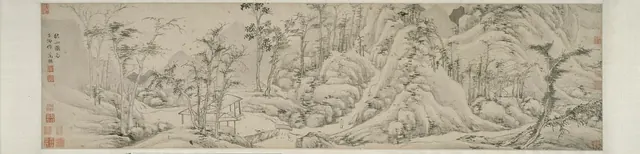
A solitary traveller with a staff climbs through autumn mountains. Wen Zhengming, a leading Ming scholar-painter, made this handscroll in the early sixteenth century. A poem by Shao Bao accompanies it, proposing particular sympathy for autumn mountains after wind and rain. Painting and writing connect seasonal decline with resilience.
Numerous horizontal strokes build the mountains. They describe ledges while making a surface worth examining closely. Restrained drawing avoids sharp contrasts. Small variations of pressure and density sustain the expansive composition.
An open building stands among slender trees. Small and almost empty, it occupies a break between slopes. Dwellings become occasional stopping places. Humans can inhabit this world without dominating it. Mountain scale makes their presence seem especially brief.
A little bridge crosses the stream. The path appears in open ground and between rocks and trees. Unrolling the scroll gradually, a viewer could imagine continuing along it. Horizontal format turns viewing into a prolonged passage where each new section changes what came before.
The traveller climbs a slope with a staff. A few lines distinguish him from surrounding rock, providing human measure. An upward path implies effort. Beside sparse dwellings, the figure gives solitude a concrete form: someone makes an actual journey within the pictured world.
Slender trees on the left carry little foliage. Sparse drawing accords with the autumn title. Shao Bao’s poem describes strong wind, rain and fading groves. The plants connect the scroll’s quiet surface with harsher weather registered in their appearance.
Writing and red seals accompany the left side. The poem attached to the work develops another thought. Winter follows decline, while pine and cypress remain. Its ending shifts attention from lost leaves towards endurance, offering a moral reading of the natural cycle.
In scholarly painting, another person’s text could continue an artist’s work. Wen gave mountain forms a restrained rhythm; Shao Bao found trial and endurance in seasonal change. Their exchange leaves room for the viewer’s response. A solitary walk can suggest an arduous climb or release from crowded life. Path, scattered houses and extensive empty land support both possibilities.
- Medium
- Handscroll; ink on gold-flecked paper
- Collection
- Art Institute of Chicago
- Dimensions
- 32 × 489 cm
- Accession number
- 1948.103
Sources
Image provided under CC0. A detail of the scroll is shown. Dimensions refer to the work catalogued by the museum. Image licence
Adapted and translated from Art Institute of Chicago materials. · Text licence