The Rocky Mountains, Lander's Peak
Albert Bierstadt · 1863
Explore the painting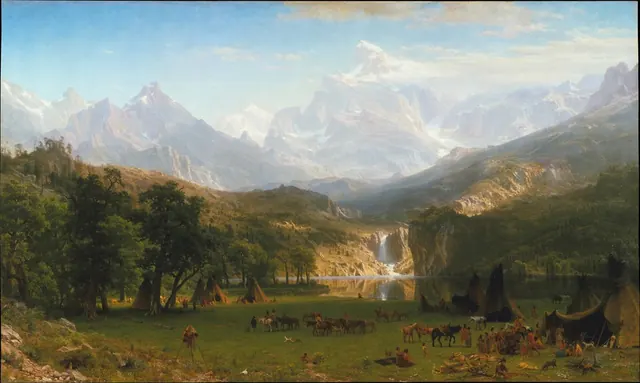
Bierstadt painted this enormous landscape in New York in 1863, using material gathered on a western journey. In 1859 he accompanied Frederick Lander’s expedition and worked in the Wind River mountains of present-day Wyoming. The finished painting assembles observations into an ideal spectacle rather than reproducing one location with photographic precision.
Pale peaks rise above dark forests, their scale vastly exceeding the human figures. For audiences in eastern cities, such painting made the distant West visually accessible. The title connected the region to the survey expedition’s leader, placing an outsider’s name on the image.
A waterfall leads the eye from the mountains toward the lake. Clear water, forest, and open space create an attractive succession of natural resources. In American culture of the period, such views could support westward settlement. The territory’s beauty helped make it desirable.
A Shoshone settlement occupies the foreground. People go about daily life among lodges and horses. Land presented to distant viewers as a discovery was already inhabited. The figures’ small scale does not make their presence secondary to the place’s history.
Lodges stand beneath a wooded slope. In her museum commentary, Cherokee artist Kay WalkingStick emphasizes the settlement’s family life and the threat to these ways of living. The destruction of bison undermined Indigenous livelihoods. The idyllic view preserves a world already subjected to destructive change.
Horses and people occupy the shore. Their active foreground contrasts with the mountains’ almost inaccessible height. That juxtaposition supports different readings: an attractive spectacle for an outside audience and an inhabited place where people’s daily lives continue.
Bierstadt records the Shoshone presence while making their land into a painting for an outside market. Those actions can coexist. A landscape may inspire admiration for nature and participate in a culture of territorial appropriation. WalkingStick’s contemporary response restores a continuing history to people too easily overlooked beneath the luminous peaks.
- Medium
- Oil on canvas
- Collection
- The Metropolitan Museum of Art
- Dimensions
- 186.7 × 306.7 cm
- Accession number
- 07.123
Sources
Image provided under CC0. Image licence