Books and Scholars’ Accoutrements
Yi Taek-gyun · late 1800s
Explore the painting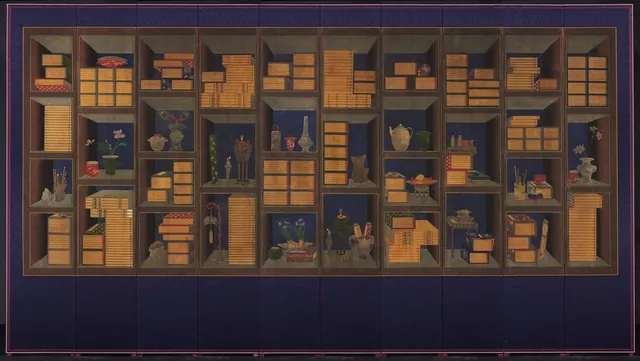
A ten-panel folding screen depicts bookshelves on an almost human scale. Such paintings were called chaekgado, pictures of bookshelves. The genre appeared at the Korean court in the second half of the eighteenth century before entering aristocratic studies. This example was made by the court painter Yi Taek-gyun in the late nineteenth century. It offers a portrait of an educated owner in which books and objects take the person’s place.
The shelves appear at varying angles. Dark walls and pale edges create the impression of deep compartments on a silk surface. When the screen stood folded, actual joins between panels added another layer of space. Viewers encountered a combination of real furniture and painted furniture. The depicted cabinet could extend a room while organising it around an image of learning.
Books lie in horizontal stacks, their edges repeating as fine lines. They occupy most compartments. In Joseon society books signified knowledge and social distinction; Korean collectors travelled to Beijing for new publications. Yet on the screen we chiefly see quantity, order and bindings. The volumes’ contents remain inaccessible. An image of learning operates before anyone opens a book.
Vessels, incense burners, small rocks and plants stand between the books. Curator Sooa McCormick identifies Yixing teapots, bronzes, crackle-glazed ceramics and other collectable objects here. The study joins reading to enjoyment of rare materials and skilled workmanship. Learning approaches collecting. An owner’s taste can be expressed through selection, juxtaposition and the space allotted to each object.
Brushes of different heights stand in a small holder. Their slender shafts contrast with heavy horizontal stacks. They are implements for future action: writing or painting. Beside accumulated books they introduce the possibility of making a text oneself. The screen presents the study’s possessions together with activities expected of its owner.
The artist concealed an image of his own seal among the compartments. It helped researchers restore Yi Taek-gyun’s name to the work. His identifying mark belongs to the same world of objects as the books and vessels. This is an ingenious way to sign an illusion: the mark belongs both to its maker and to the depicted collection. An imposing interior preserves a small trace of the labour that created it on silk.
In King Jeongjo’s account of a comparable screen, courtiers initially mistake painted shelves for real ones. The ruler explains the pleasure available simply from books’ presence. The story reveals the genre’s double power. A painting affirms respect for knowledge while offering a convincing outward representation of it. For later owners it could express a love of reading, social ambition or both at once. A painted library makes their proximity particularly visible.
- Medium
- ten-panel folding screen; ink and color on silk
- Collection
- Cleveland Museum of Art
- Dimensions
- Painting only, 139.3 × 330.8 cm
- Accession number
- 2011.37
Sources
Image provided under CC0. Image licence