Virgin and Child with Saints
Berlinghiero · c. 1230s
Explore the painting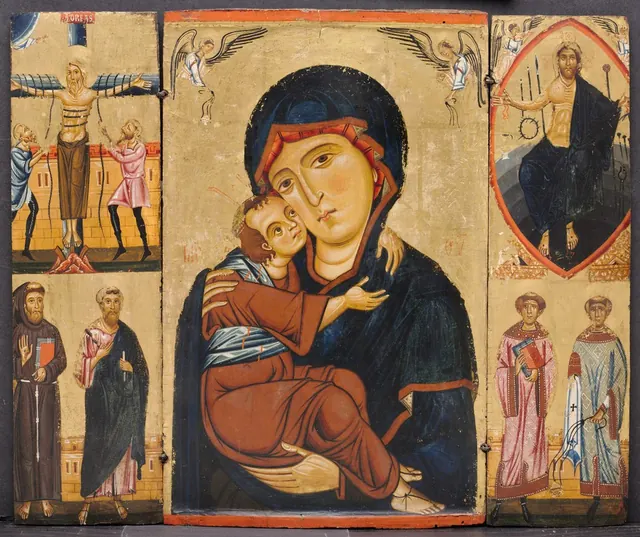
Mary presses the Child to her cheek while scenes of suffering and sanctity unfold beside them. Berlinghiero made this small folding image around 1230. His workshop worked in Lucca, an important Italian artistic centre long before Florentine painting’s ascendancy. Tempera and gold cover poplar panels. Hinged wings allowed the image to be closed and carried.
Mary’s face touches Jesus’s. The child’s arm encircles his mother’s neck, forming a close embrace. This type of image developed within Byzantine tradition. It conveyed physical intimacy through clear, recognizable gestures. Tenderness was available to a medieval painter within a rigorously ordered religious image.
The Child’s body extends along his mother’s arm. Light fold lines articulate the fabric, and bare feet emerge beneath it. His face retains a gravity exceeding that of an ordinary infant portrait. The image combines a baby’s dependence with Christ’s dignity, already known to the believing viewer.
Saint Andrew is crucified on the left wing. The small scene appears beside the embrace of mother and child, bringing suffering into view alongside tenderness. Different moments of sacred history become available simultaneously. The devotional image gathers them into a shared memory that the eye can traverse in its own order.
The right wing presents Christ with the instruments of the Passion. They recall the future earthly suffering of the child at the centre. The wings connect intimacy and loss without a sequential narrative. What appears at the right sends us back to Mary’s face, changing the emotional shade of her embrace.
Francis and Paul stand at the lower left, with Stephen and Lawrence at the right. Clothing and attributes distinguish them. The inclusion of the recently living Francis was particularly contemporary in the thirteenth century. Older and newer saints form a community around the central pair, joining different periods of Christian history.
Closed wings turned the painting into a shut object; opened, they created a small devotional setting at home or in a private chapel. The image required hands to move and eyes to approach. Its life depended on its owner’s repeated attention. In a museum, permanent display replaces that intimate practice: the familiar composition now tells a history of art while retaining traces of its earlier use.
- Medium
- triptych (tabernacle); tempera and gold on poplar panel
- Collection
- Cleveland Museum of Art
- Dimensions
- Overall, 42.6 × 51.5 cm
- Accession number
- 1966.237
Sources
Image provided under CC0. Image licence