Death of the Virgin
Master of Heiligenkreuz · c. 1400
Explore the painting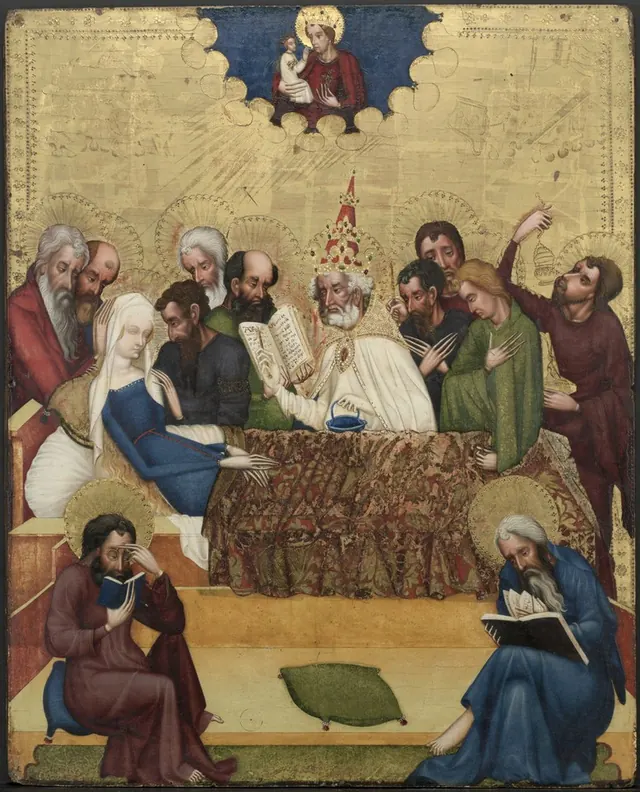
The apostles gather around the bed of the dead Virgin. Peter reads prayers and performs funerary rites. The panel was painted around 1400 by a master whose actual name is unknown. Its companion was The Death of Saint Clare, now in Washington. The pairing supports a proposed use in funerary or commemorative services among Poor Clare nuns. A story about the end of earthly life helped a community confront its own losses.
Mary lies across almost the entire picture. Her blue dress distinguishes her among warm colours, while a patterned textile covers her lower body. The bed’s long horizontal becomes a focus for the standing people. Their faces do not repeat a single response. Some read, others fold their hands or incline their heads. Shared worship holds together differences in the participants’ behaviour.
Peter stands centrally in white vestments and a papal tiara. The apostle appears through an ecclesiastical office medieval viewers associated with his successors. An ancient event takes the form of a recognisable service. The book and ritual implements connect the earliest Christian community with the church of the painter’s time. Consolation accompanies an affirmation of ecclesiastical continuity.
Above, Christ holds a small white figure representing Mary’s soul. Scale changes according to meaning: the soul appears as a child beside the adult Christ. Below the mother dies; above the son receives her. This reverses the familiar Madonna and Child. Maternal protection returns to Mary as Christ’s care for her, and death becomes a passage between two forms of presence.
A bearded apostle in blue reads in the foreground. He sits apart from the crowded row beside the bed, close to the viewer’s space. Reading establishes its own connection to the event. Text accompanies the vision of death; repeating it during worship allowed those present to act like the depicted apostles. The picture brought observation of sacred history close to ritual participation.
At left a reader holds spectacles before his eyes. This small implement belongs to late medieval everyday experience. Nearby the gold background carries barely visible angels incised and punched into its surface. Domestic specificity and precious convention work together. Spectacles make letters visible, while changes in the light on gold reveal the scene’s heavenly participants to viewers.
Saint Clare, founder of the order of Poor Ladies, appeared in a comparable setting on the companion panel. Her death was associated with Mary’s, affirming the sanctity of the life chosen by the nuns. Rich gold and textiles thus existed within a culture of voluntary poverty. They could express the sacred image’s dignity and a promise of heavenly glory. Separated between museums, the panels are easier to regard as individual masterpieces; their former relationship reveals their particular significance for a women’s community.
- Medium
- tempera and oil with gold on panel
- Collection
- Cleveland Museum of Art
- Dimensions
- Image, 66 × 53.3 cm
- Accession number
- 1936.496
Sources
Image provided under CC0. Image licence