The Titan's Goblet
Thomas Cole · 1833
Explore the painting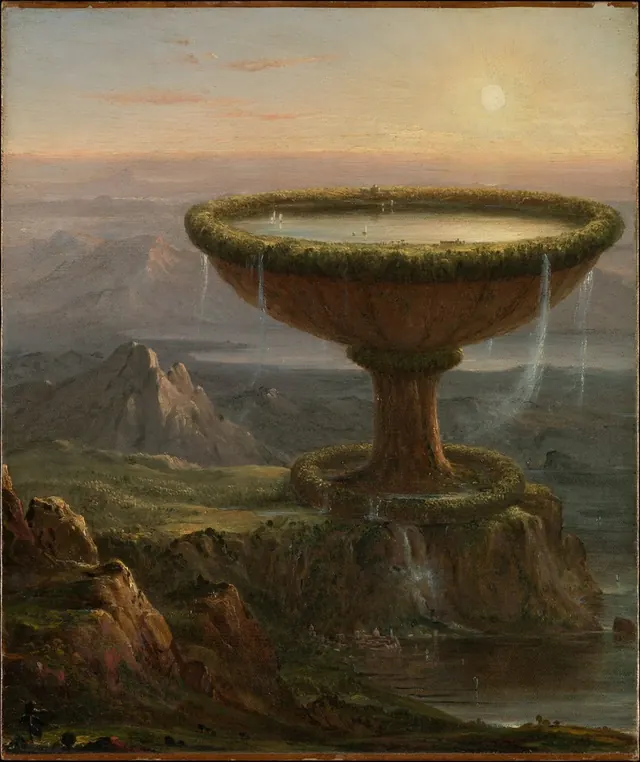
An enormous goblet stands among mountains. Sailboats move across the water in its bowl, while trees and buildings occupy its rim. Thomas Cole painted this fantasy in 1833 after traveling in Europe. Less than half a meter high, the canvas disrupts familiar scale. An ordinary vessel becomes the size of an entire country, surrounded by an even more extensive mountain world.
Tiny sails appear on the smooth water, making the bowl an inhabited space. Without them it might look like a huge object abandoned among rocks. Navigation introduces a human measure and the possibility of life within the form. Two scales coexist: a vessel seen in its entirety and a lake that must be traveled across.
Forest, ruins, and small buildings occupy the rim. Classical remains suggest time already elapsed within this unusual world. Cole studied Italian scenery and ancient architecture on his travels. His fantasy combines those impressions without reproducing a particular location. Nature accumulates human structures, while those structures gradually become part of nature.
Several narrow streams spill over the rim. The bowl remains connected to the surrounding landscape even though its inhabitants are raised far above it. Elwood Parry’s study compares the form with volcanic lakes and their outlets, which Cole could have encountered in Italy. This hypothesis relates individual details to the painter’s travels while leaving room for mythological readings.
The thick stem resembles a trunk beneath the broad spreading bowl. John Falconer, an artist who later owned the painting, connected this form with the Norse world-tree. Another early viewer, Theophilus Stringfellow, saw a self-contained human world within vast nature. These readings share a visible foundation: a small civilization fits entirely within something much larger.
Water and tiny buildings appear again below the goblet. The outer world is inhabited too, so the upper bowl does not contain all human existence in the painting. Its isolation can be read as either advantage or limitation. A high rim protects a space of its own while separating its occupants from the vast terrain around. Both possibilities remain within the fantasy’s construction.
Cole sent the painting to his patron Luman Reed, who returned it. James Mapes subsequently acquired it and allowed its exhibition in 1834. Even an established patronage relationship did not guarantee acceptance of an unusual invention. The work developed a history of owners and interpreters seeking an appropriate myth for its world. Its convincing visible form has outlasted any single explanation.
- Medium
- Oil on canvas
- Collection
- The Metropolitan Museum of Art
- Dimensions
- 49.2 × 41 cm
- Accession number
- 04.29.2
Sources
Image provided under CC0. Image licence