Merahi metua no Tehamana (Tehamana Has Many Parents or The Ancestors of Tehamana)
Paul Gauguin · 1893
Explore the painting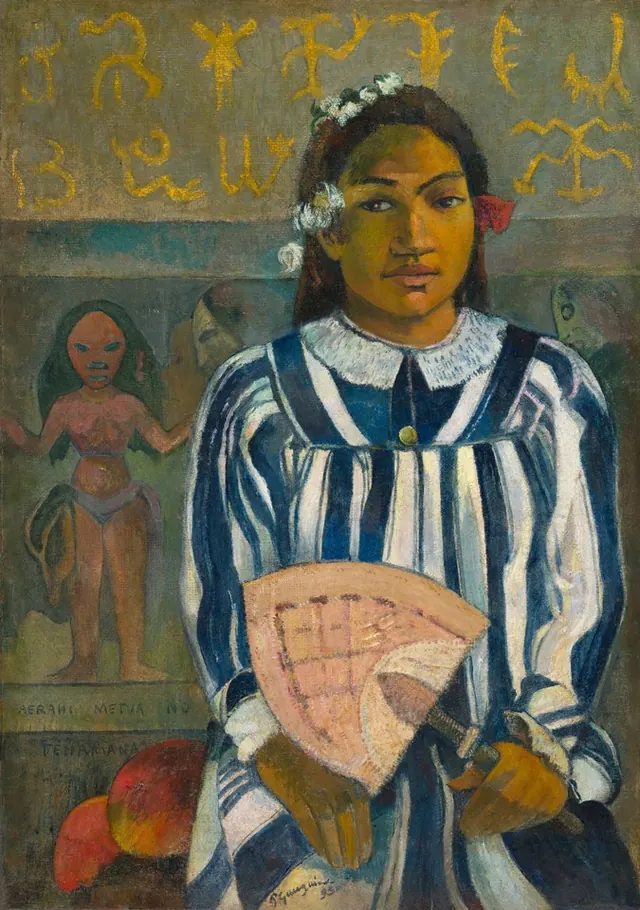
Gauguin painted Tehamana in 1893, before returning from his first Tahitian stay. She was an adolescent living with an artist in his forties. Much of the account of their relationship comes from his Noa Noa, which mixes memory with invention. The portrait names her, while its surrounding signs also reveal the island image Gauguin offered European audiences.
Tehamana looks almost directly towards the viewer. Her face holds a stable position above the striped dress. In Noa Noa, Gauguin wrote that she was thirteen when they met; the accuracy of his account remains debated. Her age materially changes how the portrait is understood. Much of her biography reaches us through the account of the adult European with whom she lived.
She holds a plaited fan resembling Samoan examples. Technical examination shows Gauguin changed its contours during painting. The object belongs to a deliberate arrangement. It also recalls connections and exchanges among Pacific cultures, which never formed one unchanging world.
The blue-and-white high-necked dress belongs to clothing promoted by Christian missionaries. They encouraged local women to cover their bodies in European cotton dresses. Her clothing reveals a Tahiti already transformed by colonisation. Gauguin’s search for untouched antiquity conflicts with the sitter’s visible modernity.
White flowers decorate the hair beside her face. Their light patches repeat the collar and the fabric’s stripes. A natural ornament and imported clothing form one outfit. The scholar Claire Frèches-Thory read the dress and fan as a combination of different cultures and periods.
Mangoes lie near the lower edge. The museum associates ripe fruit with fertility within the portrait’s programme. That interpretation reveals meanings the artist assigned to a young sitter beyond her biography. Gauguin makes details of the portrait into symbols within his own conception of island life.
Yellow signs above her head derive from Rapa Nui’s rongorongo writing. Gauguin used a photograph of a tablet whose individual signs scholars have identified. These are not ordinary Tahitian script. Material from another island supplies an imagined antiquity.
The goddess on the left combines Polynesian and Indian sources. Gauguin assembles a sacred setting of his own. European viewers might mistake such a mixture for evidence of an observed rite, although it results from selecting and reworking images.
The title has been translated as both Tehamana Has Many Parents and The Ancestors of Tehamana. One relates to Polynesian upbringing by birth and foster parents; the other directs attention towards antiquity. Translation changes her story. A particular person survives within a cultural image largely authored by Gauguin.
- Medium
- Oil on jute canvas
- Collection
- Art Institute of Chicago
- Dimensions
- 75 × 53 cm
- Accession number
- 1980.613
Sources
Image provided under CC0. Image licence
Adapted and translated from Art Institute of Chicago materials. · Text licence