Ia Orana Maria (Hail Mary)
Paul Gauguin · 1891
Explore the painting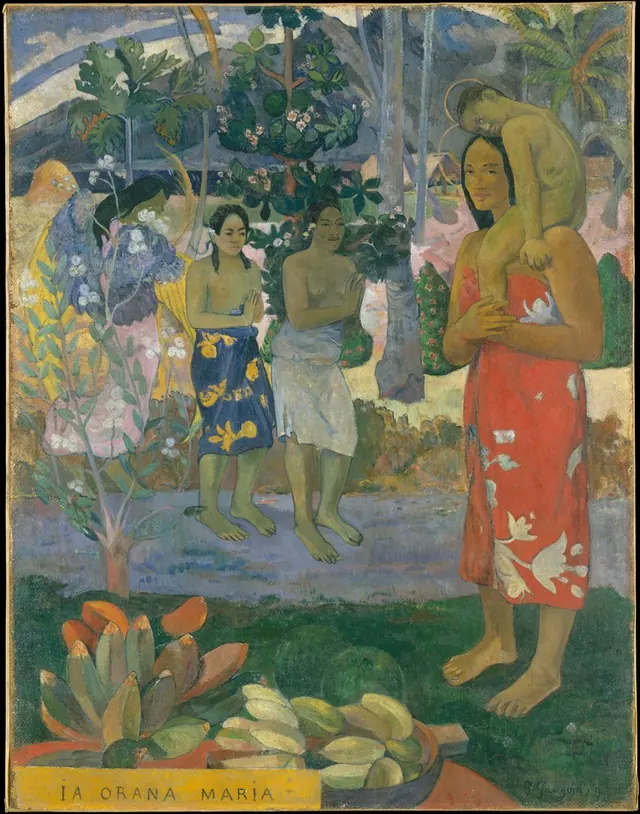
Gauguin gives a Christian subject Tahitian figures in his first major canvas made there. Much of the arrangement derives from a photograph of a relief at Java’s Borobudur temple. The painting combines different cultural sources within a European artist’s construction of Tahiti.
The woman in a red floral skirt turns left. Gauguin gives Mary a local appearance and clothing.
The child sits high on his mother’s shoulder. His position differs from common European Madonna images.
Two women hold their hands together. Their poses relate to the borrowed photograph of a Javanese temple relief.
A winged figure stands among flowers on the left. The angel introduces a recognisable Christian element into the composite setting.
Large leaves and cut fruit fill the foreground. Vegetation contributes to a constructed image of tropical abundance.
A slender trunk divides the standing figures. Natural forms organise groups drawn from different sources.
Gauguin reached Tahiti in 1891 after working with Pissarro and artists in Brittany. The picture is his transformation of Christian and Asian models, with Tahiti and Java remaining distinct places.
- Medium
- Oil on canvas
- Collection
- The Metropolitan Museum of Art
- Dimensions
- 113.7 × 87.6 cm
- Accession number
- 51.112.2
Sources
Image provided under CC0. Image licence