View of Delft
Johannes Vermeer · c. 1660–1661
Explore the painting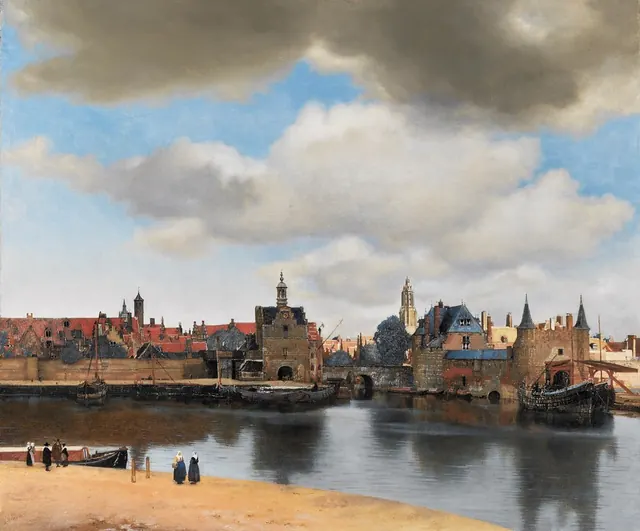
Vermeer painted Delft around 1660–1661, looking across the harbour from the city’s southern side. Boats lie moored, the water is almost still, and a broad band of reflections separates us from the buildings. This order seems natural, but comparison with old views reveals adjustments and simplifications. He organised a recognisable city into an unusually clear whole. His precision concerns visual experience as much as individual buildings.
Two small groups converse on the near bank. The figures are clear enough for us to distinguish the turn of their bodies, but they do not become narrative heroes. Their size helps establish the water’s width and the gates’ height. Open space separates them. We can begin without one compulsory focal point and gradually shift attention from people to the city they inhabit.
Buildings continue downwards in dark bands of reflection. Horizontal strokes cross them and suggest slight movement on the surface. Above, each object retains architectural definition; below, water loosens it. Vermeer connects precise construction with changing perception. The city appears heavy and stable on its bank, yet mobile in its own reflection.
The New Church tower is brighter than the surrounding structures. It contained William of Orange’s tomb and held particular significance for Dutch history. Vermeer shifted the tower slightly towards the centre. His selection becomes especially clear here. Light singles out a monument of collective memory while appearing to result from passing clouds. Historical importance enters the landscape through entirely plausible weather.
Sky occupies much of the canvas. A dark cloud above the nearer buildings and the water below form broad shadowed areas. Between them the sunlit architecture further away appears particularly distinct. The city attracts attention despite occupying limited space. Vermeer builds depth through differences of illumination. A tower or roof becomes conspicuous because of a broad surrounding area that does not itself demand detailed inspection.
The boat at right carries many tiny pale dots. Close up they resemble separate drops of paint; from farther away they suggest water sparkling against a dark surface. Vermeer does not describe every plank with equal precision. He changes his handling to convey what a viewer sees under this light. Exact gate edges coexist with an almost abstract scattering of marks.
This city can appear an image of order and prosperity. Yet a harbour remains a place of transport, trade and daily work, much of which is not developed into separate episodes. The painting’s calm is a selection within urban life. It need not be deceptive, but it does not exhaust that life. Vermeer shows how truthful observations can form a carefully chosen image of a place.
- Medium
- Oil on canvas
- Collection
- Mauritshuis, The Hague
- Accession number
- 92
Sources
Reproduction of a public-domain artwork. Image licence