The Milkmaid
Johannes Vermeer · c. 1660
Explore the painting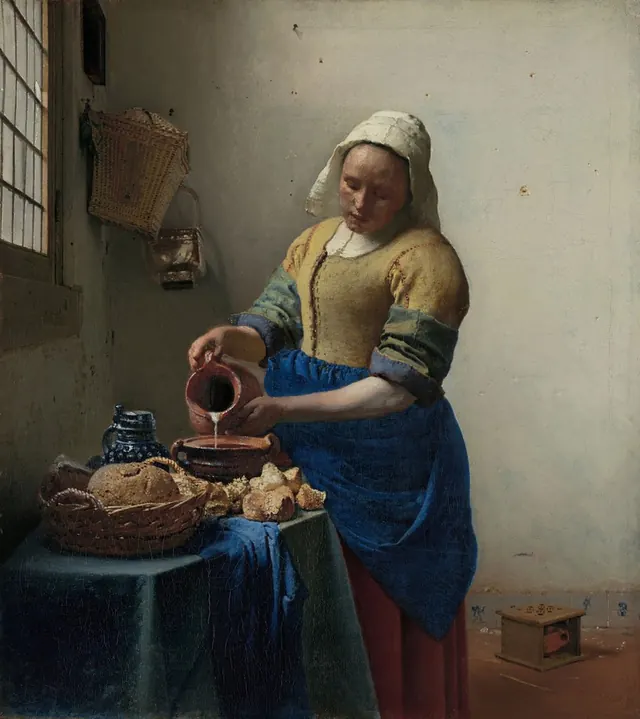
A woman pours milk into a kitchen vessel. She is a domestic servant preparing food, rather than a milk seller. Vermeer painted her around 1660 in Delft, where he lived and worked. This small genre painting gives unusual significance to an ordinary task. Her substantial figure occupies almost the room’s entire height, while its only conspicuous movement is concentrated in a thin stream.
Her head inclines towards the jug. The white cap catches light from the window while her face remains partly shaded. She neither poses for us nor returns our gaze. Her attention belongs to the task, allowing us to observe someone who appears not to perform for an audience. Yet the scene is carefully constructed: an impression of incidental observation also requires composition.
She supports the heavy jug with both hands and controls its tilt. The stream connects her hands to the vessel on the table, holding our attention within that short interval. The action cannot be completed in a single instant. As we watch, the milk seems to keep flowing. The duration of ordinary work becomes the painting’s subject without an adventure or a dramatic resolution.
Bright dots cover the bread crusts. Instead of outlining every irregularity, Vermeer assembles the impression of a surface from separate highlights. Glazed pottery, a woven basket and folded cloth appear beside it. These objects belong to food preparation while also giving the painter different ways to show light on rough, smooth and soft surfaces.
The window at left supplies directional daylight. The wall behind the woman is almost empty, although holes and irregularities remain visible. This background clarifies her arms and the outline of her head. The setting never disappears into abstraction: a basket and metal vessel remain beside the window. Yet there are few enough objects for the woman’s work to command attention.
A foot warmer stands on the floor with a small container for embers inside. Decorated tiles run along the wall. Such details return us to the organisation of a seventeenth-century household, where warmth and food preparation required particular equipment. Pictorial stillness does not erase the material conditions of labour. Behind the beautiful yellow and blue are hands, utensils, provisions and the need to maintain a home.
The servant’s labour receives a scale and dignity often associated with more elevated subjects. At the same time viewers enjoy the calm of someone else’s work without sharing its burden. Both relationships coexist. A task household employers might take for granted demands sustained attention here. Light rests on hands, bread and milk, making the maintenance of daily life worthy of a painting in its own right.
- Medium
- Oil on canvas
- Collection
- Rijksmuseum, Amsterdam
- Dimensions
- 45.5 × 41 cm
- Accession number
- SK-A-2344
Sources
Reproduction of a public-domain artwork. Image licence