Liberty Leading the People
Eugène Delacroix · 1830
Explore the painting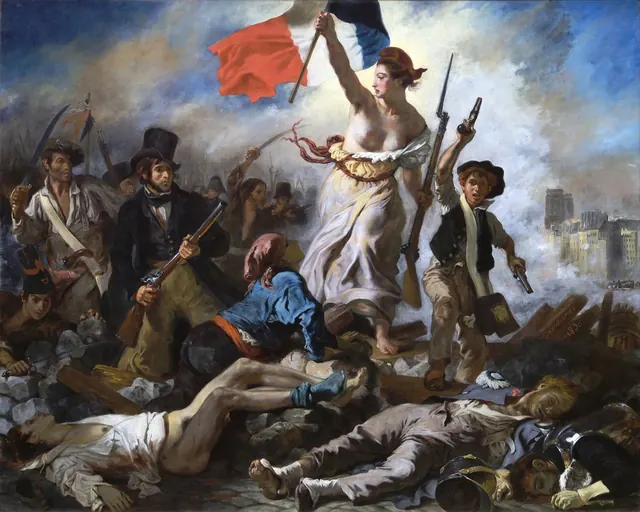
The Paris uprising of 27–29 July 1830 prompted Delacroix’s unusual turn to a recent event. He painted the canvas from September to December, while memories of street fighting were fresh. The French tricolour rises above a barricade. The woman carrying it personifies Liberty, given a human body and a place among armed citizens.
Liberty walks barefoot, turning towards the people. One hand holds the flag and the other a musket with a bayonet. Antique drapery and an exposed breast meet contemporary weaponry. The figure belongs simultaneously to street combat and allegory. A particular uprising thus acquires the scale of a historical model recognisable beyond July 1830.
A man in a top hat holds a gun beside people dressed differently. Variations in clothing suggest a heterogeneous crowd. The top hat and the neighbouring fighter’s open shirt retain differences even within a shared movement. Delacroix assembles expressive social types. Their proximity sustains an idea of common action, while individual faces prevent the mass from becoming wholly schematic.
A boy with two pistols advances beside Liberty and slightly ahead of her. His open mouth and raised arm continue the upward movement. He is often associated with Gavroche, although Hugo’s novel appeared later. A child’s presence increases the scene’s energy while changing its ethical meaning. It can suggest courage and also show how widely violence reaches.
A kneeling figure looks up at Liberty. Blue, white and red in the clothing echo the flag. Gaze and colour connect the painting’s lower region to its summit. The composition forms a pyramid based on rubble and bodies. Pictorial order transforms the disorder of a street clash into movement with a direction.
The dead lie in the foreground. Their bodies are closer than the victorious flag, and we must look across them towards those advancing. Liberty’s raised arm does not remove this obstacle. Cropping the lower part produces a much simpler image of triumph. The complete format makes political exhilaration and its human cost visible together.
Restoration in 2023–2024 recovered subtle colour relationships obscured by darkened varnish and later interventions. The painter’s work became easier to see behind the famous symbol. Yet the picture’s political force also depends on selection. Different people gather beneath one allegory while their disagreements remain outside the canvas. A persuasive image of unity can express common hope and simplify the actual complexity of revolution at the same time.
- Medium
- Oil on canvas
- Collection
- Musée du Louvre, Paris
- Dimensions
- 260 × 325 cm
- Accession number
- RF 129
Sources
Reproduction of a public-domain artwork. Image licence