The Third of May 1808 in Madrid, or The Executions
Francisco Goya · 1814
Explore the painting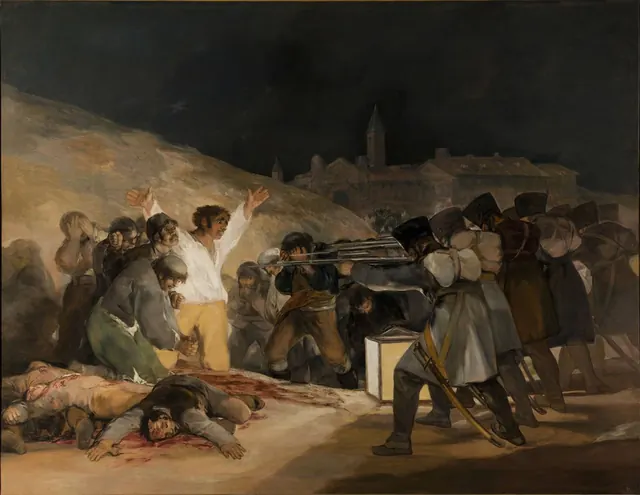
After Madrid’s uprising on 2 May 1808, Napoleon’s troops executed prisoners and detained civilians. Goya painted this scene in 1814, when the war had ended and Ferdinand VII was returning to Spain. Six years separate the event from the canvas. The commission originated under the regency as a commemoration of resistance to the French. Its companion shows street fighting; this picture depicts the consequences of suppression.
A man in a white shirt kneels with his arms spread wide. His figure is brighter than the others, and his face turns directly towards the guns. The pose exposes his whole body. His name is unknown, and the painting gives him no signs of rank or authority. At the centre of a history painting stands an unarmed person whose life depends on the soldiers’ next action.
The guns point in nearly parallel lines. The soldiers bend in similar poses, their faces hidden from our position. Legs, straps, sleeves and barrels repeat. This arrangement presents the firing squad as a coordinated group. Among the condemned, individual faces and hand positions remain distinct. The difference is established through the organization of figures, without an explanatory inscription.
A lantern stands on the ground between the groups. It lights the white shirt, faces and hillside while leaving the soldiers’ backs darker. The light source belongs to the execution setting itself. It helps the soldiers aim and makes their victims visible to the viewer. Goya uses a simple object to link the mechanics of the scene with its effect: the brightest area is also the most dangerous.
Dead bodies already lie before the kneeling man. One has arms spread across the earth almost as widely as the living figure above. Their poses establish a sequence within a single still image. The lower edge brings the bodies close to us, leaving little protected distance inside the depicted space. A shot already fired and the next one expected stand side by side.
The man beside the white shirt covers his face with his hands. Others wait close behind. Goya gives them no uniform heroic pose. Prayer, a covered face and a gaze towards the soldiers coexist in the same lit area. These are different visible responses to what is happening. Gestures establish them without invented biographies or final thoughts.
The distant city buildings almost merge into the night. Only rooflines and a tower remain visible. The execution belongs to Madrid, but the architecture does not securely establish an exact location. The principal group is pressed against a slope, with no open route behind them. The arrangement intensifies their dependence on the soldiers facing them.
Goya was shaping public memory of the war after a change of government. He presented the cost of resistance through the bodies of unarmed people. The work is not an on-the-spot record, and the Prado rejects the popular story that it was originally displayed in the streets. Its force comes from a historical event and a carefully chosen position from which to confront its consequences. We see the condemned men’s faces and almost none of the soldiers’ faces. Sympathy is directed before we learn the circumstances. The arrangement can be read as an indictment of execution as a mechanism. Yet the soldiers’ anonymity tells us nothing certain about their individual convictions. Goya gives the image a strong moral position, which should be distinguished from a complete explanation of war.
- Medium
- Oil on canvas
- Collection
- Museo Nacional del Prado, Madrid
Sources
Reproduction of a public-domain artwork. Image licence