The Fighting Temeraire
Joseph Mallord William Turner · 1839
Explore the painting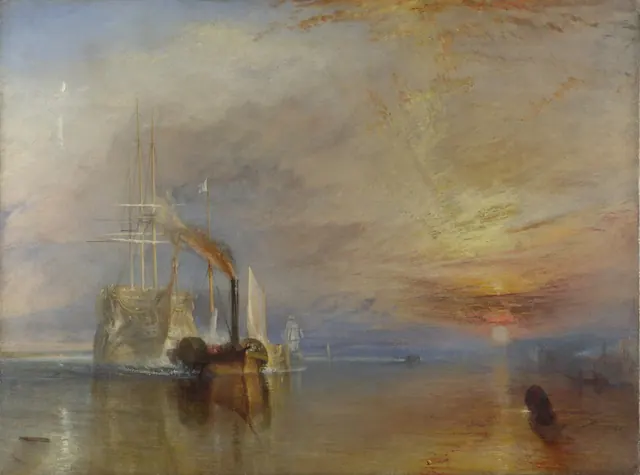
In September 1838, the old warship Temeraire was towed up the Thames to be dismantled. It had fought at Trafalgar in 1805, but the navy now sold it for its timber. Turner exhibited his painting the following year. Between a great pale vessel and a small steam tug, he constructed an account of memory, technological change and a military symbol becoming saleable material.
The large ship still has masts. In reality, these had been removed before sale along with reusable equipment. Turner restored its recognizable appearance and replaced its black-and-yellow paintwork with pale tones. The painting therefore cannot serve as an exact account of the towing. It preserves an image of the former ship within the scene of its disappearance.
The tug ahead looks denser and darker. Its smoke crosses the sailing ship’s rigging. Turner altered the funnel’s position relative to the mast to obtain this effect, objecting when an engraver tried to correct the design. The visible consequence is clear. The machine occupies less space but determines the larger vessel’s movement. Size and power no longer coincide.
The sun sets on the right. This suits a final voyage expressively, although the route’s geography would not permit the sunset in that position. Contemporary viewers noticed the discrepancy. Turner organized the lighting around the painting’s construction, connecting the day’s end with the end of the ship’s service. A landscape motif gains meaning through proximity to a specific historical event.
The orange reflection spreads over the water, balancing the ships on the left. Up close it separates into strokes; from a distance they become a surface reflecting the sky. Turner leaves many objects indistinct and makes light the principal way of distinguishing distances. The water fills the space before us without a detailed grid of waves.
The tug’s dark reflection binds it more firmly to the water. The old ship’s tall masts appear much lighter. This can be read as a contrast between a working machine and a sailing vessel preserved in memory. Yet Turner used modern transport and painted steamships and railways. The picture allows regret at a loss without condemning all new technology.
A thin crescent appears high on the left, small beside the great sunset glow. Sun and moon together extend the sense of time within one moment of towing. Their coexistence can be related to changing conditions and generations of technology. The neighbouring details support that reading without giving the crescent one compulsory meaning.
Patriotic memory emphasizes the ship’s achievement, while economic history recalls the sale of old timber. Crew members and shipyard workers almost disappear from the majestic image. Their absence raises a question about whose history survives alongside a military symbol. Turner kept the work until his death; it then entered the national collection, becoming an object of shared memory itself.
- Medium
- Oil on canvas
- Collection
- National Gallery, London
Sources
Reproduction of a public-domain artwork. Image licence