Whalers
Joseph Mallord William Turner · ca. 1845
Explore the painting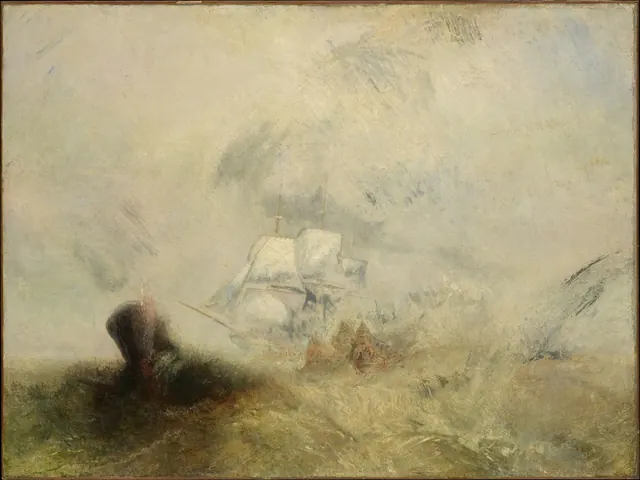
Turner was seventy when he exhibited Whalers at the Royal Academy in 1845. Hunters pursue a whale, but figures, boats, and a ship almost dissolve into water and light. This manner unsettled contemporaries. William Makepeace Thackeray mocked the difficulty of recognizing objects. Turner makes the hunt’s danger perceptible through the instability of what can be seen.
The whale’s dark mass emerges through foam at the left, beside water tinged red. Its body is not completely outlined, but its scale greatly exceeds the nearby boats. Wounded animal and hunters occupy a confined space. The prey’s size promises a substantial catch while making every approach hazardous.
Short dark strokes indicate figures in the boats, crossed by longer lines of equipment. At a distance, the boats first register as small brown marks. Beside the whale they appear vulnerable. The hunt requires approaching a creature capable of overturning the fragile balance of this small human group.
The distant ship survives as a few mast verticals and pale patches of sail. Its outlines are weaker than the whale’s dark mass nearby. Even the large vessel offers little visual stability. Air, spray, and water soften the division between an object and its surroundings, leaving only fragments of its form.
At the right, pale paint gathers into foam and wave crests. Each stroke describes water while remaining a visible trace of the brush. From farther away, the marks form a sea surface. Close up, it breaks into touches and accumulations. Turner preserves this difference, letting paint convey movement without a smooth contour for every wave.
The pale sky almost merges with the sea. As the horizon fades, hunters occupy an immense shared space. The painting was apparently intended for Elhanan Bicknell, whose wealth came from the whale-oil trade. He returned it to Turner. A patron connected to the trade’s profitability received an image that makes its activity difficult to contemplate calmly.
This work belongs to four whaling scenes exhibited in 1845 and 1846. Human courage and violence against an animal coexist. A viewer can sympathize with the people in the boats while recognizing them as the attackers. Turner provides no safe vantage separate from the hunt. The image’s uncertainty draws us into a situation in which everyone’s view is restricted.
- Medium
- Oil on canvas
- Collection
- The Metropolitan Museum of Art
- Dimensions
- 91.8 × 122.6 cm
- Accession number
- 96.29
Sources
Image provided under CC0. Image licence