The Last Supper
Leonardo da Vinci · 1495–1498
Explore the painting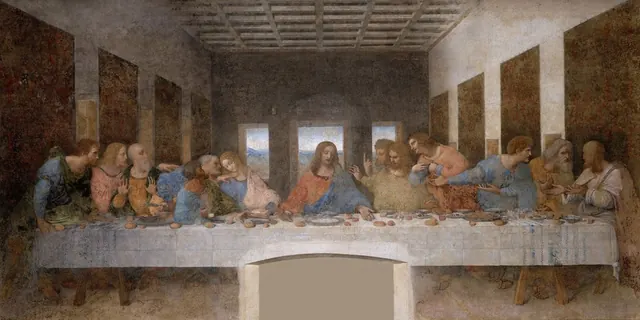
In the refectory of Milan’s Santa Maria delle Grazie monastery, the friars faced Christ’s final meal with his disciples during their own daily meals. Leonardo worked on the mural in the 1490s while serving the Sforza court. The subject suited the room’s function, but he gave it a specific moment of action. Christ has announced that one of those present will betray him. The twelve apostles respond through questions, exchanges and gestures.
Christ sits before the central window. Open intervals remain beside him while the apostles crowd into groups. His arms and inclined head form a broad, stable shape, and the light opening makes his face easy to locate. The centre stays legible even for someone viewing the immense mural from the opposite end of the actual refectory.
Peter, John and Judas form a close cluster to Christ’s left in the image. Peter leans forward, John turns towards him, and Judas withdraws into shadow. Their place at the same table matters. The betrayer remains among the disciples, so the tension arises within the shared group. Differently turned heads convey several responses to one statement while maintaining connections between neighbours.
To Christ’s right, one apostle spreads his arms, another brings his hands to his chest, and a third raises a finger. Leonardo studied how bodily positions could convey a person’s inner response. The mural makes that interest visible. The actions differ enough for our gaze to move from person to person while remaining focused on the same event. Gestures make the scene readable without labels above each participant.
Ceiling lines and side walls converge behind Christ. The painted architecture extends the real room while obeying its own perspective. Dark rectangles along the walls diminish into the distance. Their regularity maintains order around the animated gathering. Geometry and human responses work together, preventing the many figures from breaking into disconnected episodes.
Bread, dishes and small vessels sit on the white tablecloth. Their low arrangement leaves the hands clearly visible. For the monastic audience, the meal also carried religious meaning connected with Christ’s final days and the institution of the Eucharist. Ordinary table objects linked sacred history to the daily communal meal taking place beneath the mural.
The large opening below was made later and destroyed part of the scene beneath the table. The surface bears other losses as well. Leonardo painted on dry plaster so that he could work slowly and make revisions, but the paint proved fragile. Damage was noticed in the early sixteenth century. Today’s appearance cannot be treated as the untouched mural its first viewers encountered.
Pinin Brambilla Barcilon directed the restoration from 1977 to 1999. Specialists distinguished surviving original passages from later repainting that sometimes covered Leonardo’s work. Despite the losses, the central construction remains. One spoken statement connects the people, each responds differently, and the ordered architecture lets us follow those responses. Space, bodies and action together make the mural exceptionally legible. Today a visitor mainly studies a celebrated composition. The monks ate in front of another meal, one connected with the foundation of their faith. That proximity changed the meaning of an everyday act. A reproduction preserves the apostles’ gestures but can lose the relationship between the image and the room’s life. Understanding the commission means imagining the tables, people and recurring monastic routine below it.
- Medium
- Experimental painting on dry plaster
- Collection
- Museo del Cenacolo Vinciano, Milan
- Dimensions
- 460 × 880 cm
Sources
Reproduction of a public-domain artwork. Surviving wall painting with losses and a later doorway. Image licence