Book of the Dead for the Chantress of Amun, Nauny
Unidentified Egyptian painters · ca. 1050 BCE
Explore the painting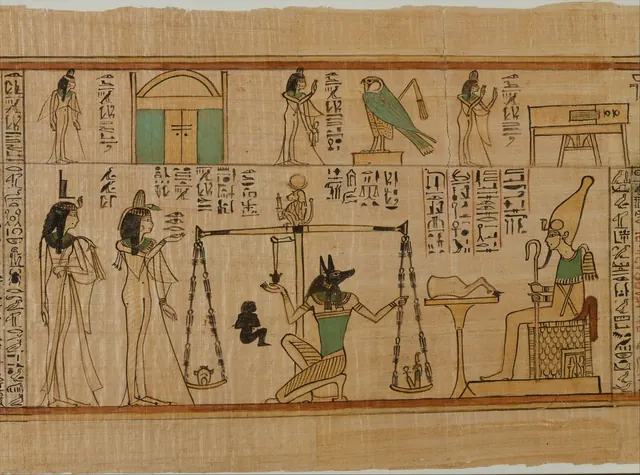
Nauny, a chantress of Amun, undergoes judgment after death. We see the central episode of a papyrus more than five metres long, made around 1050 BCE. The scroll was placed in her burial inside a wooden figure of Osiris. Its texts and images were intended to help this particular deceased woman attain a favourable afterlife.
Nauny stands to the left of the scales, holding representations of eyes and a mouth in her raised hand. According to the accompanying text, a favourable judgment restores her ability to see and speak. This unusual gesture concerns bodily faculties necessary for life after death.
Nauny’s heart occupies one pan; the other holds a tiny figure of Maat, the embodiment of cosmic order and ethical conduct. This is an important feature of this particular image. The feather familiar from other papyri does not lie alone in the pan here: it belongs to the goddess’s figure.
Canid-headed Anubis kneels beside the scales to check their position, holding part of the apparatus. The balance is level: the image already shows a favourable judgment. The viewer is not asked to wonder whether Nauny will be condemned. The papyrus establishes the desired outcome for its owner.
A baboon, one form of Thoth, god of writing and wisdom, sits on the beam. His presence concerns recording the result. Columns of hieroglyphs stand nearby. Writing and image work together: figures show the procedure, while text specifies its meaning and applies it to Nauny.
Osiris sits at the right. Funerary wrappings enclose his body, and his hands hold a crook. A meat offering lies before him. As god of rebirth and ruler of the afterlife, he receives the judgment, connecting the deceased woman’s examination to the hope of continued life.
Nauny appears several times in the upper band, including before Horus in falcon form. Repetition of one figure indicates different actions. These scenes sit above the judgment without attempting to represent a single room. The papyrus organises a religious sequence on a surface where each episode remains legible.
Such a book can easily be treated as an illustrated account of Egyptian beliefs. For Nauny it was an effective funerary object from which assistance was expected. That changes the questions we ask: both the scene’s content and its guaranteed favourable outcome matter. The papyrus records hopes and ritual means of fulfilling them, rather than an independent verdict on a person.
- Medium
- Papyrus, paint
- Collection
- The Metropolitan Museum of Art
- Dimensions
- 521.5 cm
- Accession number
- 30.3.31
Sources
Image provided under CC0. A detail of the scroll. The complete work extends beyond this museum reproduction. Image licence