Funerary Papyrus of Tayuhenutmut
Unidentified Egyptian painters · Third Intermediate Period, probably Dynasty 21 (about 1069-945 BCE)
Explore the painting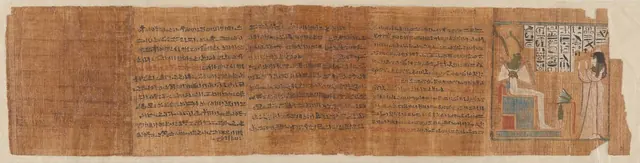
This papyrus was prepared for a temple singer named Tayuhenutmut, whose name means “mistress of Mut” and refers to the Egyptian goddess. Placed in a burial, it was intended to assist her after death. Text and image performed a practical religious function: preserving identity, securing protection and enabling continued existence in the afterlife.
Osiris, ruler of the afterlife, sits enthroned on the right, with an offering table before him. The picture identifies the god receiving the prayer even before its words are read. Yet the illustration occupies only a small part of the long sheet. Most of the surface is reserved for language required on its owner's journey.
Tayuhenutmut stands with raised hands, a gesture of praise. Her name makes the scene personal: these religious formulas were intended for a particular woman. Her appearance follows established conventions rather than supplying a verified portrait likeness. Identity is maintained above all by the named individual and her presence before the deity.
An offering between the woman and the throne connects them within one ritual action. Objects remain easily recognisable, without complex foreshortening. The arrangement clearly presents what the rite requires. The drawing's visual clarity supports its role in preserving the order of a sacred event.
Large hieroglyphic signs appear above the participants. Farther left, smaller writing fills long lines. Differences of scale distinguish the encounter with the god from the extended text. A modern viewer may respond to the signs as ornament, but their meaning mattered more to the papyrus's purpose than the regular pattern they formed.
The scribe copied five spells from nearly two hundred known possibilities in the Book of Going Forth by Day, now commonly called the Book of the Dead. It was not a single book necessarily reproduced in full. Tayuhenutmut received a selection, including assistance in remembering her name. Egyptians believed that a forgotten name threatened the deceased's continued existence. Naming therefore did more than label a portrait.
The papyrus brings together two means of preserving a person. The figure follows a shared convention, while the name identifies one particular owner. How does our reading change when we remember that this museum object was meant to remain in a burial and assist the dead? We encounter historical evidence and art; for Tayuhenutmut, the image and words formed part of a hope for her own continued existence.
- Medium
- Papyrus and pigment
- Collection
- Art Institute of Chicago
- Dimensions
- 24.5 × 101 cm
- Accession number
- 1894.180
Sources
Image provided under CC0. Image licence
Adapted and translated from Art Institute of Chicago materials. · Text licence