Persimmon Tree
Sakai Hōitsu · 1816
Explore the painting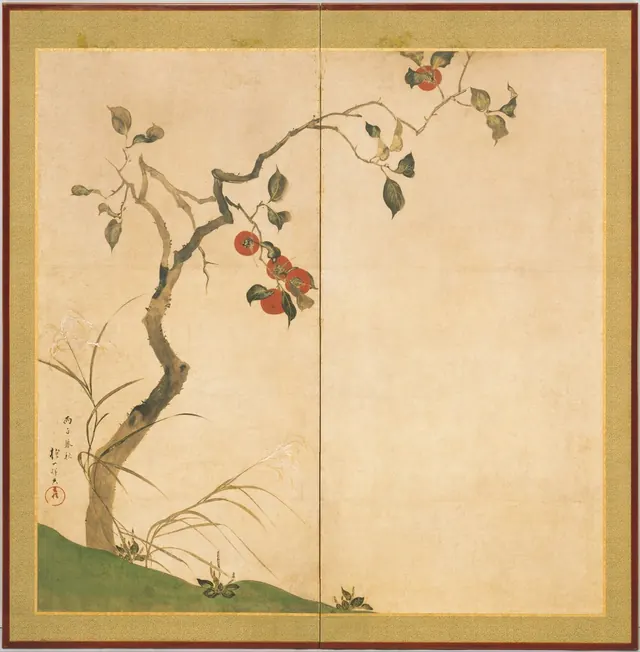
A single persimmon tree remains on this two-panel screen. Sakai Hoitsu painted it in late autumn 1816, with fruit still on the branches and leaves already curling. This restrained landscape emerged from a refined urban culture. The painter came from a wealthy samurai family and received a broad artistic education.
The trunk begins at the lower edge and rises diagonally. Rather than a heavy tree occupying the center, the painter selects an elongated form. Branches distribute the image across both panels. Open areas keep each division visible and preserve lightness at the scale of a screen.
Orange fruit supplies the most saturated touches of color. Despite their small size, they hold attention. Autumn appears through a particular condition of the plant. Leaves are thinning while fruit remains conspicuous; the season requires neither a separate event nor a human figure.
Leaves curl and change direction. Hoitsu studies natural form closely while preserving the silhouette’s decorative clarity. His training encompassed several painting traditions. The plant’s persuasiveness comes from their combination.
Uneven ink patches spread through the trunk. The tarashikomi technique introduces pigment or ink into a still-wet layer. The result suggests bark while retaining traces of the material’s movement. The drying process participates in the image’s final form.
The signature and seal connect the tree to a particular author and moment. A year earlier, Hoitsu published a collection of one hundred works by Ogata Korin. He actively preserved and reinterpreted an artistic inheritance. The screen’s natural motif belongs to the history of observation and to the transmission of models between artists.
This screen’s simplicity requires considerable accumulated knowledge. Behind one tree lie Hoitsu’s education, study of predecessors, and experience with ink. Wealth appears in the capacity to select a little with great care. Luxury and restraint could support one another in his artistic culture.
- Medium
- Two-panel folding screen; ink and color on paper
- Collection
- The Metropolitan Museum of Art
- Dimensions
- Image, 143.7 × 143.8 cm
- Accession number
- 57.156.3
Sources
Image provided under CC0. Image licence