Flowers of Autumn and Winter
Suzuki Kiitsu · 19th century
Explore the painting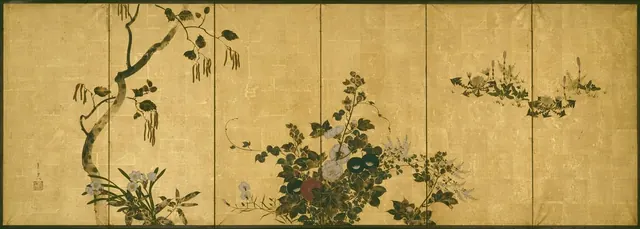
Autumn flowers gather at the centre of this golden screen, while winter plants stand on the left. Suzuki Kiitsu painted it in the nineteenth century within Japan’s tradition of seasonal imagery. It was probably paired with a second screen showing spring and summer. Together they could bring a full year into a domestic interior, offering comparisons of flowering, ripening and withering.
On the left, a stalk carries darkened, shrivelled beans. Its curve occupies a substantial area of empty gold. The end of growth receives as much attention as an open blossom. The season includes different states of plants, including those usually excluded from a festive bouquet.
Fine tendrils extend from the central group into open space. They show Kiitsu’s precise arrangement of distances between large masses and small lines. He initially trained as a textile dyer before studying painting with Sakai Hoitsu. Experience of fabric and pattern entered his representation of nature.
Narcissus flowers stand at the lower left. Pale petals and long green leaves remain distinct against the shining background. They belong to the winter part of the composition. Viewers familiar with Japanese seasonal culture could recognise the time of year through a plant, without snow, a calendar or an explanatory label.
Hibiscus, morning glories and other autumn flowers join in the centre. Crossing stems form a dense, bouquet-like group, but the setting remains unspecified. Gold provides no precise account of planting or illumination. The plants can be experienced as garden observations and as carefully placed coloured forms.
The lower leaves are partly cut off by the edge, suggesting continuation beside the viewer. Kiitsu belonged to the Rinpa tradition, which joined decorative force to engagement with earlier masters. He assisted Hoitsu in preparing a compendium of Ogata Korin’s paintings, helping transmit this language to new generations.
Small plants at the upper right stand apart from the main group. They seem raised into the air, yet their placement suggests looking deeper into a garden. An actual empty patch of gold also serves as distance. The image allows movement between a flat pattern and imagined space.
A seasonal screen connected its owner with nature through a luxurious object. Its flowers are selected and arranged according to a cultural memory of the year. Admiration can lead to a question about how choosing beauty shapes our attention to growth and decline. Kiitsu left room on the gold for both.
- Medium
- Six panel screen; ink, colors and gold leaf on paper
- Collection
- Art Institute of Chicago
- Dimensions
- 72.4 × 207.6 cm
- Accession number
- 1961.1001
Sources
Image provided under CC0. Image licence
Adapted and translated from Art Institute of Chicago materials. · Text licence