The House of Bijapur
Kamal Muhammad and Chand Muhammad · ca. 1680
Explore the painting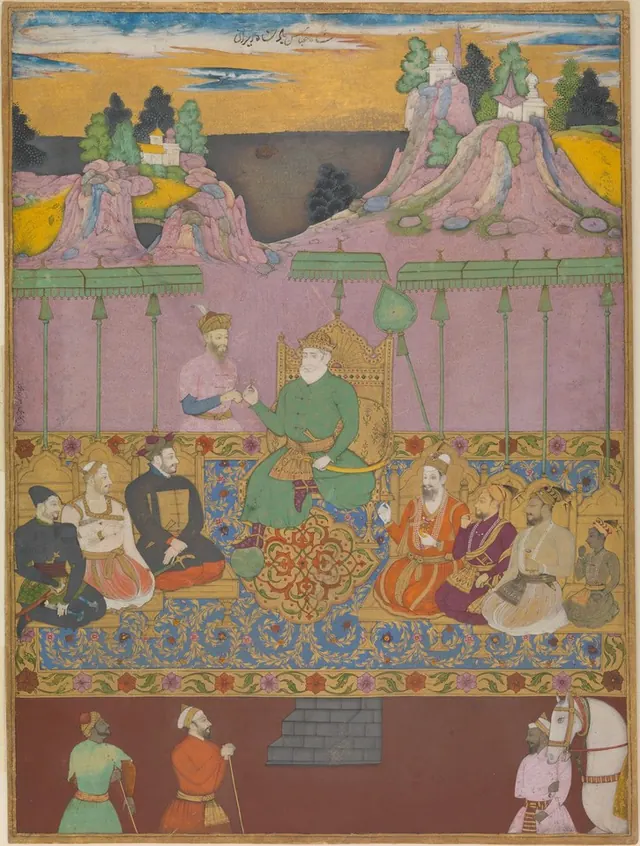
Nine Adil Shahi sultans appear together in an assembly made for the young Sikandar. The painting dates shortly before Bijapur fell in 1686. An exchange of a key invokes dynastic legitimacy and links with Safavid Iran. A later inscription misidentifies the Iranian ruler and cannot be accepted at face value.
A ruler in green sits on a raised throne. The change in level distinguishes the principal figure within the assembly.
A pale-clad figure reaches toward the throne. The exchange of a key connects the scene with recognition of authority and Bijapur's ties to Safavid Iran.
Turbaned rulers sit at the left. The image brings together members of different dynastic generations who could not have assembled at the same time.
The row of seated sultans continues at the right. Nine rulers present the history of the Adil Shahis as a single courtly gathering.
A large patterned carpet covers the platform. Its edges separate the rulers' space from the area occupied by attendants.
Pink rocky hills rise above the palace garden. The landscape extends the image beyond the ceremonial platform.
Attendants stand below the raised platform. Differences in level and seating convey the hierarchy of the court.
The museum credits two painters, Kamal Muhammad and Chand Muhammad. They worked for Bijapur's last ruler. Soon after the painting was made, the Mughals conquered the city, ending the dynastic succession represented here.
- Medium
- Ink, opaque watercolor, gold, and silver on paper
- Collection
- The Metropolitan Museum of Art
- Dimensions
- Page, 41.3 cm
- Accession number
- 1982.213
Sources
Image provided under CC0. Image licence