Mountain Market, Clearing Mist
Xia Gui · early 13th century
Explore the painting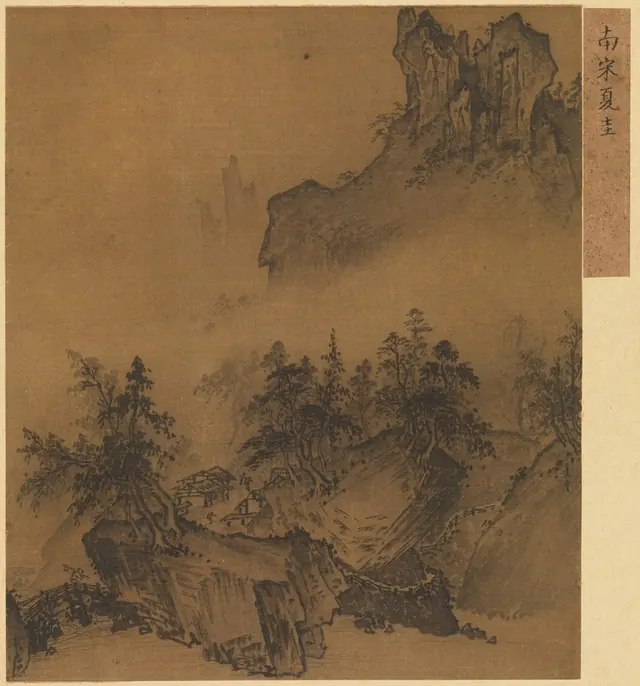
A small market lies at the foot of a mountain. Xia Gui painted it in ink on silk in the early thirteenth century, on a leaf about twenty-five centimeters high. The subject belongs to the Eight Views of the Xiao and Xiang Rivers, a well-known group of landscape themes. The defining event is the clearing weather. After rain, mountains, trees, and buildings gradually emerge through damp air, while daily life continues at the edge of a much larger natural setting.
Roofs cluster tightly below the slope. For the painter’s contemporaries, the motif had a poetic history. The monk Huihong wrote about a mountain market where silkworm trading ends and the crowd thins after rain. His poem includes a bridge, roadside willows, and a distant wine-shop flag. Such recognizable details supplied a painter with material for an entire world, without requiring a literal illustration of every line.
At the lower left, a bridge crosses the water. A path approaches it, connecting the buildings with the surrounding landscape and establishing a human scale. Reaching the market means crossing water and passing between shore and mountain. Even on this small leaf, the settlement has routes of communication. What initially looks like a secluded corner belongs to the movement of people and goods.
The mountain peak occupies the right side. Sharp dark strokes and softer washes construct its slopes. Wedge-shaped marks are called ax-cut strokes because they resemble cuts in wood. A single pressure of the brush defines a rock face, while diluted ink beside it produces a less definite surface. Solid stone and damp air emerge from the same material handled differently.
In the middle of the leaf, mountain outlines dissolve into a pale area. This interruption in drawing represents mist. The terrain must partly be connected in the imagination through the fragments still visible. Weather changes how the landscape can be perceived. The detailed settlement gives way to a barely distinguishable distance, so a short span of silk contains a wide change in visibility.
Trees and small dark marks near the buildings are painted economically. At this distance, a single stroke can suggest a crown of foliage or a human figure. The brush retains its movement within a recognizable image. The Met connects Xia Gui’s expressive shorthand with the later development of calligraphic painting under the Yuan, when the character of a line became particularly important to personal expression.
Poet and painter choose a moment when trading subsides and the weather clears. The market’s work remains behind this calm, even when individual transactions are no longer visible. For some people the valley was a place of livelihoods and roads; for an album viewer it became a small landscape held close at hand. The painting joins those experiences, turning familiar economic life into a carefully selected poetic view.
- Medium
- Album leaf; ink on silk
- Collection
- The Metropolitan Museum of Art
- Dimensions
- 24.8 × 21.3 cm
- Accession number
- 13.100.102
Sources
Image provided under CC0. Image licence