Terracotta krater
Attributed to Hirschfeld Workshop · ca. 750–735 BCE
Explore the painting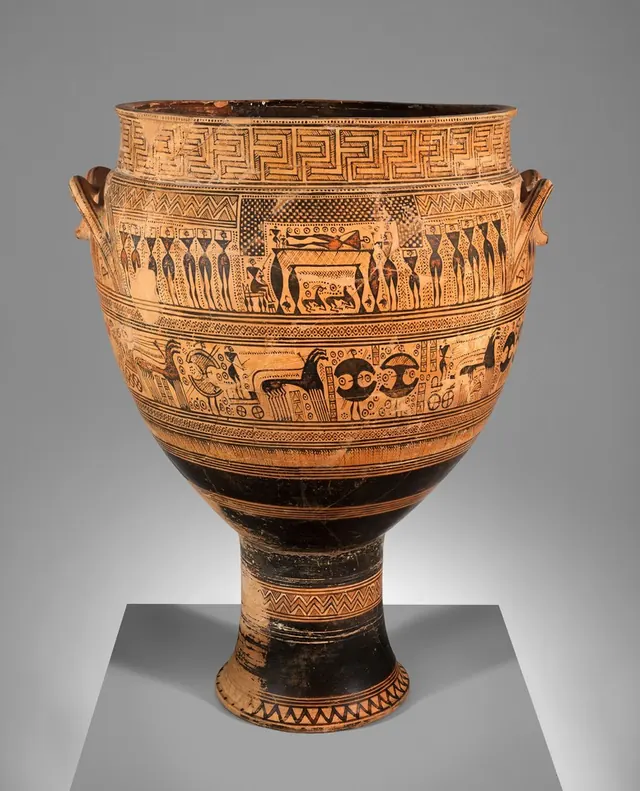
This vessel, more than a metre tall, served as a grave marker. It was made in Athens around 750–735 BCE, when monumental clay vases marked graves but stone statues had not yet become a customary form of funerary monument. Its decoration commemorated the deceased through scenes of mourning and a ceremonial procession.
The deceased lies in the vessel’s widest band. His body is shown from the side, with a chequered rectangle representing the funerary shroud spread above him. In the actual ritual the cloth would have covered the body. The painter separates them so that both the person and the covering remain visible.
Mourners raise their hands to their heads. Their torsos become dark triangles and their legs long thin lines. The repeated gesture identifies a collective action. Individual portrait likeness is unnecessary for understanding it: the figures are distinguished principally by their places beside the bier.
Chariots and armed men move in the band below. Little space remains between horses and wheels, yet individual forms stay distinct. Unlike the stationary bier above, this band suggests movement around the vessel. The memorial brings a motionless body together with a continuing procession.
Some shields narrow at the middle. Such shields and chariots evoke the martial world of the earlier Bronze Age. The museum proposes that they refer to prestigious ancestral traditions rather than literally record the dead man’s battles. Precision in depicting an object does not by itself make an image a historical chronicle.
A meander, a continuous line with right-angled turns, runs around the neck. Triangles, diamonds, and checks fill other bands. These forms gave the Geometric period its name. Human figures belong to the same system of clear lines while retaining recognisable gestures and actions.
The tall foot lifts the decorated body above the ground. The broadest band, containing the bier, sits above the lower ornament, giving the funerary scene more room. The painting accommodates the vessel’s volume; this photograph shows only part of a decoration that continued around it.
Commissioning such a monument enabled a family to present the deceased and his ancestry publicly. We do not know how closely the procession corresponded to his own life. The vessel can therefore be read both as a representation of ritual and as a claim about how someone should be remembered. Hirschfeld Workshop is a modern conventional name, not a surviving artist’s signature.
- Medium
- Terracotta
- Collection
- The Metropolitan Museum of Art
- Dimensions
- Height, 108.3 cm
- Accession number
- 14.130.14
Sources
Image provided under CC0. One view of a painted object. The reverse is not shown. Image licence