Buddhist Retreat by Stream and Mountains
Juran · 960–85
Explore the painting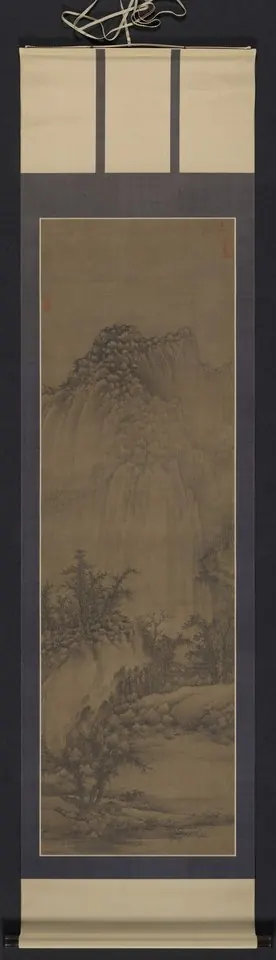
A small retreat hides among trees at the foot of an immense mountain. This landscape is assigned to Juran, a tenth-century Buddhist monk and painter. He worked at the Southern Tang court in Nanjing and moved to the northern capital, Kaifeng, after the state’s conquest in 975. The museum suggests that the painting followed this relocation, joining an established southern manner with monumental northern landscape.
The peak rises far above human habitation. Rounded rock masses gradually gather into a single volume. The hanging scroll’s vertical format intensifies the ascent. The eye travels from an accessible foreground towards heights impossible to encompass from the position of the depicted dwelling.
Long, fibrous strokes descend along the slopes. Known as hemp-fibre strokes, this technique belongs to the tradition of Dong Yuan that Juran continued. Lines give the mountain extension and structure, while dark marks above them indicate vegetation. Repeated brush movements bring the substance of rock into being.
A cluster of trees grows on a ledge before the slope. Each trunk bends differently, and branches divide into fine tips. Nearby vegetation receives more detail than distant mountains. Distance is therefore felt through the artist’s touch even though the painting uses closely related ink tones throughout.
The retreat’s roofs are barely visible among branches at the lower right. Their regular lines introduce human order into complex natural surroundings. The building’s scale emphasizes the mountain’s size, while concealment lends it shelter. Finding the human place requires the viewer to slow down and examine the lower landscape.
Water and vegetation leave open intervals around the dwelling below. They make access to the secluded place imaginable. The landscape combines remoteness with the possibility of approach. That duality matters to the retreat: it exists within a larger world while preserving its own way of life.
The museum suggests that Juran painted this landscape after moving to Kaifeng. If that dating is correct, the immense mountain brings his southern training together with approaches encountered in his new surroundings. The secluded retreat then belongs to a history of conquest, relocation and encounters between traditions. The tranquil view does not depict those events directly; the connection emerges when we learn how the painter’s life changed.
- Medium
- Hanging scroll; ink on silk
- Collection
- Cleveland Museum of Art
- Dimensions
- Painting only, 184.5 × 56.1 cm
- Accession number
- 1959.348
Sources
Image provided under CC0. Image licence