Retable and Frontal of the Life of Christ and the Virgin
Unidentified Spanish painters · 1396
Explore the painting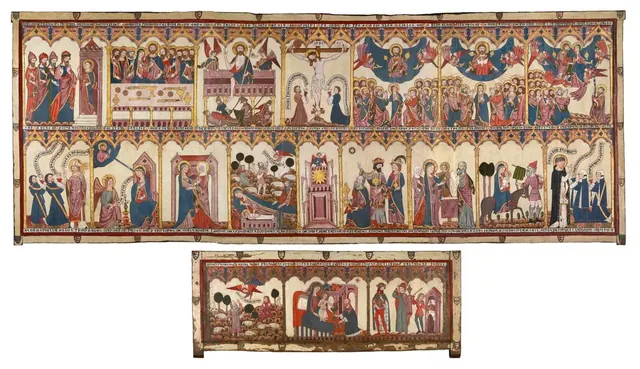
In 1396 Pedro Lopez de Ayala commissioned this altarpiece for his family’s funerary chapel in their northern Spanish palace. A courtier, diplomat and soldier, he became chancellor of Castile. Local painters assembled scenes from Christ’s and the Virgin’s lives. The work was to sustain perpetual prayer for Ayala’s family and remained in the chapel for more than five centuries.
The Crucifixion occupies the upper row’s centre. Kneeling figures turn towards Christ beside the cross. Death and hopes of salvation held particular force in a family burial setting. A central subject gathers many separate stories into a shared devotional structure.
Christ and the disciples assemble at a long table. An arch separates the Last Supper from adjacent events, with faces and gestures crowded above the cloth. Repeated architecture offers a stable system for following changing characters and actions across the surface.
Blue surrounds the ascending Christ above the disciples. Saturated ultramarine was among the costly materials used with gold and silver leaf. Religious imagery depended on substantial expenditure. Brilliant colour made scenes visible while showing the resources a family devoted to remembrance and prayer.
Two women embrace beneath an arch in the lower row. Their close figures communicate a meeting through a clear gesture. Gold grounds and schematic buildings recall manuscript illumination and earlier architectural decoration. Narrative clarity sustains the sequence across a large surface.
Farther along, Mary rides a donkey with the child while Joseph walks nearby. A few figures and trees represent the Flight into Egypt, compressing a difficult journey into a recognisable episode. Family intimacy, danger, birth and death coexist within the larger hope of salvation.
The separate lower piece, an altar frontal, covered the table’s front. Scenes connected with Christ’s birth recur there. The larger retable stood behind the table, surrounding worship at different levels. A museum assembly exposes both completely, whereas they originally belonged to a small room’s arrangement.
An empty throne occupies the large panel’s lower centre. It probably once framed a statue of the Virgin and Child. The missing figure added volume to flat scenes. Several forms of representation joined in an altarpiece that occupied the chapel as an entire structure.
Ayala, his wife Leonora de Guzman, their son and daughter-in-law pray at the lower row’s ends. Wolves and cauldrons from their coats of arms repeat around the framing, while an inscription records the donation. Piety and family position share the same means of expression. The patron placed his lineage within sacred history and secured its lasting visibility. The preserved ensemble reveals personal hopes of salvation becoming costly and publicly legible family memory.
- Medium
- Tempera and gold on panel
- Collection
- Art Institute of Chicago
- Dimensions
- Retable, 257 × 669.9 cm
- Accession number
- 1928.817
Sources
Image provided under CC0. Image licence
Adapted and translated from Art Institute of Chicago materials. · Text licence