Saint George and the Dragon
Bernat Martorell · 1434–35
Explore the painting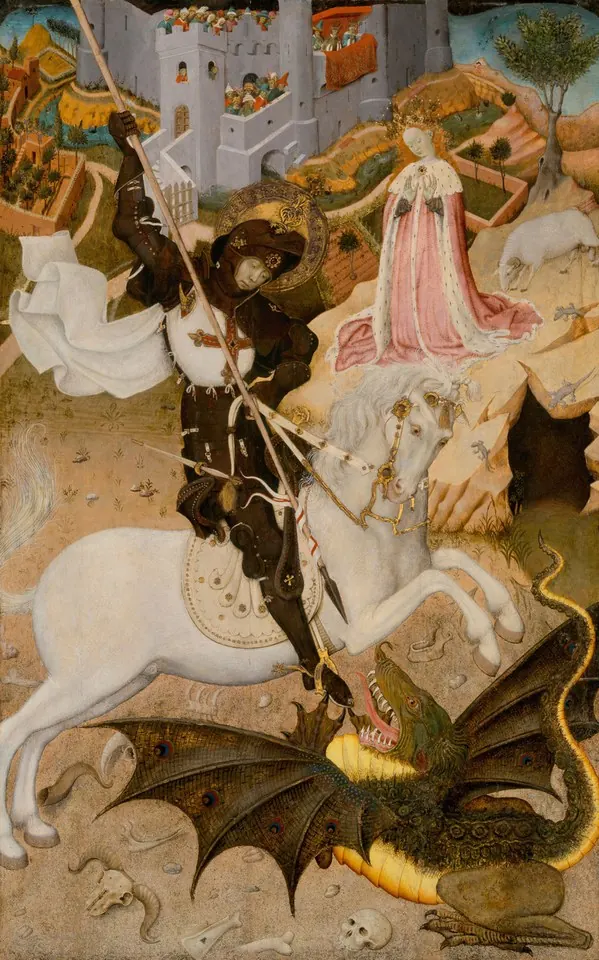
Bernat Martorell painted Saint George's victory over the dragon around 1434–35. In Christian legend, the knight rescued a princess intended as the monster's victim. This was an altarpiece's central panel, probably made for the Catalan government's palace chapel in Barcelona, although its origin is not certain. George's role as Catalonia's patron connected the image with religious practice and political representation.
A golden halo surrounds the head beneath a dark helmet. It identifies the armed rider as a saint. Martorell combined Christian knighthood with elaborate contemporary equipment. Familiar objects gave the elevated story credibility for its patrons and viewers.
The white horse rises above the dragon as a long lance cuts through the group towards its mouth. This diagonal directs attention to the blow. Gold fittings ornament the harness. The pale animal separates dark armour from scales, making the complicated struggle immediately legible.
The princess stands behind with hands joined in prayer. Crown and long mantle establish her rank. The rescuer acts through arms and the princess through prayer, placing chivalric action within a Christian story. For an altarpiece probably associated with the Catalan government, protecting the princess could echo the saint’s protection of the whole country.
The open jaws receive the lance point. Teeth, membranes and scales give a fictional creature striking physical detail. The more tangible the danger, the more impressive the saint's achievement. Familiar animal forms lend substance to a fantastic adversary.
A crowd gathers behind the castle battlements. The museum identifies the princess's parents among the spectators. Distant faces form a compressed row against the large individual figures below. An entire community benefits, although one knight performs the rescue.
A clawed foot lies beside the curling tail. Raised gesso beneath the paint enhances parts of the armour, halo and dragon's scales. Changing illumination could make the altarpiece's surface behave differently from a flat reproduction. Material helped distinguish sanctity, metallic shine and the monster's body.
Human and animal bones cover the sandy foreground, establishing danger before the rescuer arrived. Small reptiles appear near the cave; they may be lizards or baby dragons.
Four side panels showing George's martyrdom are now in the Louvre. Together they offered a fuller story in which military victory accompanied the saint's suffering. The detached centre more strongly celebrates a successful protector. Reconstructing the dispersed ensemble changes its meaning: the patron saint exemplified fidelity without guaranteeing earthly invincibility.
- Medium
- Tempera on panel
- Collection
- Art Institute of Chicago
- Dimensions
- 155.6 × 98.1 cm
- Accession number
- 1933.786
Sources
Image provided under CC0. Image licence
Adapted and translated from Art Institute of Chicago materials. · Text licence