Legends of the Yūzū Nembutsu Sect
Unidentified Japanese painters · Kamakura period (1185–1333), 14th century
Explore the painting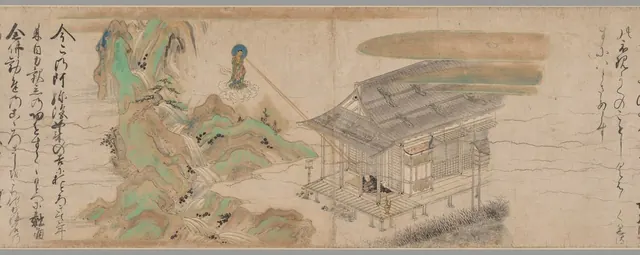
This fourteenth-century Japanese handscroll recounts the origins of the Yuzu Nembutsu school. Its protagonist Ryonin lived from 1072 to 1132 and, according to tradition, spent twenty-four years secluded in Ohara. An apparition of Amida Buddha then directed him towards other people. Several centuries separate his lifetime from the image. The scroll presents a community's account of its beginnings.
A wooden building appears in detail from two sides. Fine lines distinguish roof, walls and supports. Such precision brings the setting of a vision close to everyday experience. Architecture makes the narrative tangible.
A small figure inside the open room establishes human scale. The place of seclusion occupies much of the scene. According to the account, spiritual life changes direction here, from an individual recluse towards shared participation. Solitude and the future community form a central relationship.
Green and brown passages indicate mountains and paths. Open paper connects separated places without continuous landscape description. Enough of the surroundings appears to explain the dwelling's remoteness. The narrative does not require equal detail in every interval.
Amida appears above the slopes on a cloud, with golden rays extending towards the house. This represents a vision as transmitted by religious tradition. Ryonin is told the importance of sincerely invoking the Buddha's name and spreading the practice. Within the community, the miraculous event authorises its teaching.
Calligraphy alternates with painting. A reader unrolled roughly an arm's width at a time, connecting passages of text and image. This reproduction contains only part of a longer story. Later episodes describe Ryonin approaching the court and teaching humans and deities.
Elongated clouds cover part of the roof and separate passages. They belong to the narrative's imagery while organising the page. Open areas offer a pause after detailed architecture. Sequential viewing matters more than taking in the whole object at once.
The school’s name concerns connections among practitioners. One person’s spiritual merit was believed to benefit many, while shared practice supported each participant. Sincere invocation of the Buddha’s name offered a broad audience an accessible religious action. Ryonin’s story also includes approaching the court. Open teaching and influential patronage belong to one account of a community’s formation. The scroll preserves its founder’s memory and shows personal revelation becoming shared belief.
- Medium
- Handscroll; ink, colors, and gold on paper
- Collection
- Art Institute of Chicago
- Dimensions
- 30.5 × 1176.9 cm
- Accession number
- 1956.1256
Sources
Image provided under CC0. A detail of the scroll is shown. Dimensions refer to the work catalogued by the museum. Image licence
Adapted and translated from Art Institute of Chicago materials. · Text licence