The Tale of Genji
Unidentified Japanese painters · early 17th century
Explore the painting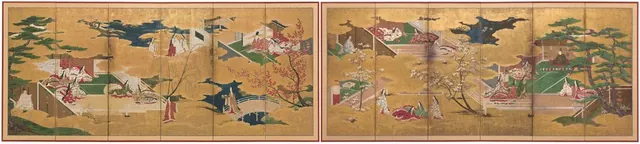
Five episodes from The Tale of Genji share a continuous landscape on these early-seventeenth-century screens. The court writer Murasaki Shikibu composed the novel in the early eleventh century. Its characters experience love, rivalry, loss and changing status. Predominantly fortunate moments appear here. This selection shows how a complex literary narrative could become a wish for a happy household.
On the left, court ladies discuss which season is most beautiful. Their conversation belongs to a culture of comparing poetry, seasonal impressions and taste. Recognising such distinctions formed part of an educated reader’s world. Painting turns a literary exchange into a scene that could be revisited within one’s own room.
Golden clouds conceal parts of the buildings and separate episodes. They join events that happen at different times. We see a shared world without treating it as a single instant. The object relies on memory of a narrative continuing beyond the rooms depicted.
Figures on a path and beside a bridge connect separate architectural areas. The curved garden crossing helps the eye travel across the panels. A screen functions both as a household furnishing and as a space for reading a favourite story. It can be surveyed at once or explored in parts through recognition.
In the upper part of the left screen, Genji and Lady Murasaki sit beside a charcoal brazier. This is one of the selected moments of intimacy. A private encounter takes its place among extensive gardens and palace buildings. Domestic well-being receives a visible form, although the novel is far more complicated than any single happy scene.
Interiors are seen from above, as if their roofs had been removed. The device lets viewers see people inside closed apartments. We gain access to courtly private life unavailable to an ordinary palace visitor. Painting opens a world whose everyday rules depended on distinctions of space and rank.
On the right, the infant Genji is presented to his father, the emperor, for the first time. His early life shares a landscape with much later events. Selected episodes replace a sequential account of all fifty-four chapters. An auspicious beginning and subsequent intimacy support the pair’s prevailing mood.
Tall pines frame the palace and continue across several panels. Figures and landscape recall the Kano school, although the painter is unknown. Luxurious literary screens furnished wealthy homes. Familiarity with courtly classics allowed owners to connect their households with a prestigious cultural past.
The museum suggests that the pair belonged to a bridal trousseau. Its fortunate episodes would then accompany a bride into her new home. The choice is striking in a novel whose relationships rarely remain untroubled. These screens reveal how a commission and an object’s function can change a familiar story’s tone, preserving its characters while setting aside many of their anxieties.
- Medium
- Pair of six-panel screens; ink, colors, and gold on paper
- Collection
- Art Institute of Chicago
- Dimensions
- 166 × 371 cm
- Accession number
- 1962.574-1962.575
Sources
Image provided under CC0. Image licence
Adapted and translated from Art Institute of Chicago materials. · Text licence