Woman in a Garden
Berthe Morisot · 1882–83
Explore the painting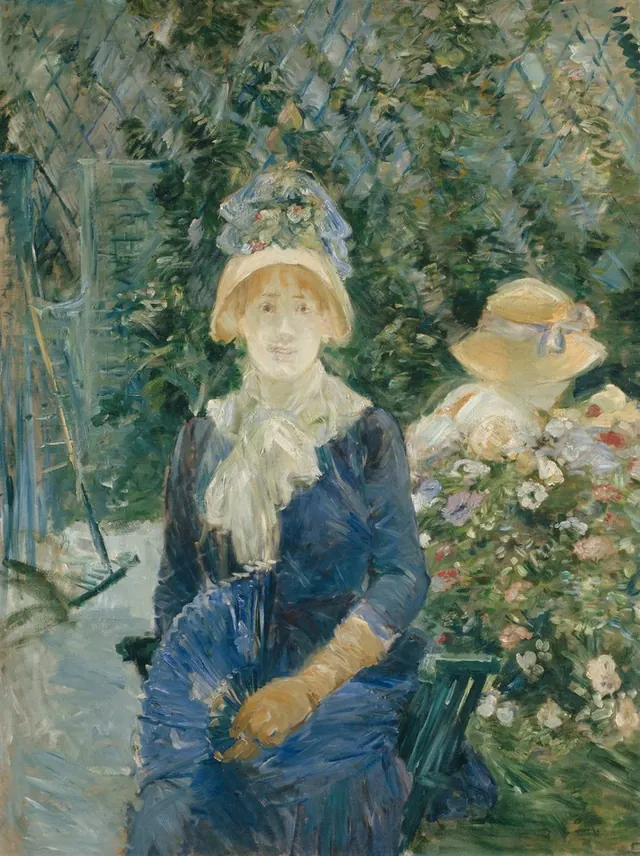
A woman in blue sits in a garden while a child nearly disappears among flowers behind her. Berthe Morisot probably began the painting in summer 1882 at Bougival, where her family rented a house. Her husband Eugène Manet and their daughter Julie, not yet four, stayed with her. The garden became both a family setting and a workplace.
The woman faces us, although her identity remains unknown. Morisot keeps her features legible while using the same mobile brushwork as in the surroundings. An individual presence survives within changing light.
Flowers and pale ribbons decorate the hat, echoing the plants behind it. Dress and garden become closely related. Fashion already incorporates transformed natural motifs, which the painter places beside living foliage and blossoms.
Long-gloved hands rest in her lap. The pose is composed enough for a portrait, while short, varied strokes animate the surroundings. Morisot joins a person sitting for her to the impression of a passing summer moment. Liveliness emerges through work on an arranged encounter.
The child in a straw hat was probably based on Julie. A turn of the head and the brim largely hide her face. She shares the picture while looking elsewhere. Familial proximity accommodates separate attention instead of gathering everyone into a formal group portrait.
Flowers on the right consist of white, pink and green touches. Related strokes cross dress and face. Morisot handles the figure almost as landscape. A unified environment allows illumination to touch the person and surroundings together.
The garden chair and dress form stable diagonals below. They support the figure amid scattered foliage. A clear distribution of structural supports underlies apparently light painting. Pictorial freedom depends on compositional precision.
Morisot was a professional participant in the Impressionist exhibitions. Home and family supplied subjects while making demands on time and care. The garden is both a place of leisure for its occupants and a workplace for the painter. Those two sides of one summer day show private life becoming public art.
- Medium
- Oil on canvas
- Collection
- Art Institute of Chicago
- Dimensions
- 123 × 94 cm
- Accession number
- 1999.363
Sources
Image provided under CC0. Image licence
Adapted and translated from Art Institute of Chicago materials. · Text licence