The Battle between the Gods and the Giants
Joachim Wtewael · c. 1608
Explore the painting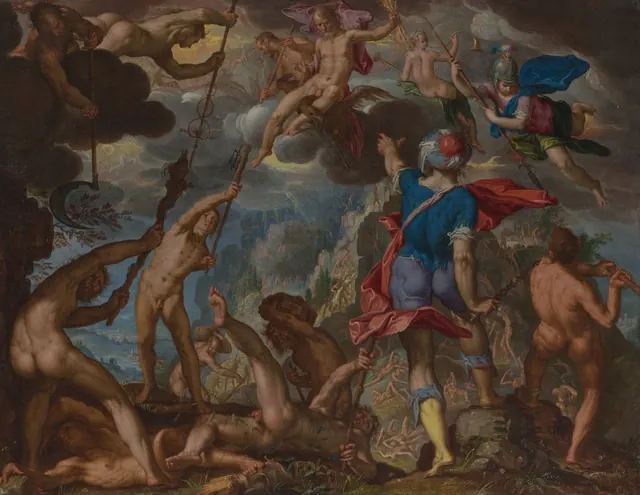
On a small copper plate, Joachim Wtewael staged a battle for which even the sky seems too cramped. Giants challenge the Olympian gods and suffer defeat. Painted around 1608 in Utrecht, the work preserves his taste for intricate poses and fantastic colours while many Netherlandish painters were turning towards more everyday, plausible representations of the world.
A fighter dressed in blue turns his back towards us. His costume, red fabric and the naked bodies around him form a dense knot in the foreground. The ancient battle offers opportunities to compare materials and foreshortening. The smooth copper support allowed tiny details to be painted with particular clarity.
Minerva appears higher up on the right, among the clouds. Her helmet identifies her, while billowing clothing accompanies her flight. The goddess of wisdom joins the defence of Olympian order. The celestial figures move freely above their opponents; below, bodies collide and obstruct one another.
A naked giant reaches upwards with a long shaft. His torso turns and his head tilts back, making the effort of his whole body apparent. Such figures exemplify Mannerism, an approach that prized artistic invention and difficult execution. Wtewael’s early travels in Italy and France helped him acquire this international visual language.
Jupiter carries thunderbolts in the upper part of the picture. Victory depends on supernatural force and an elevated position. Read as a story of order, the image vindicates Olympian authority. Attention to the bodies below brings the cost of that victory into view. The choice of myth gives the viewer both perspectives.
A sprawling figure at the bottom contrasts sharply with the gods’ secure position in the clouds. The painting’s size invites close examination. An enormous event becomes a precious object for private viewing, in which danger can be studied alongside the artist’s skill in drawing the body.
The fighters on the right recede into the distance, but no clear passage opens between them. Pinks, blues and golden tones divide the congestion into numerous movements. Wtewael’s patrons enjoyed these artificial combinations. His paintings retained their audience as other artists adopted quieter colours and simpler actions.
Later, his difference from the familiar idea of Dutch painting helped push Wtewael into relative obscurity. New exhibitions have renewed attention to the independent value of his art. This battle helps explain that reassessment. It combines ancient narrative with painting’s freedom to invent an impossible spectacle for intellectual and visual pleasure.
- Medium
- Oil on copper
- Collection
- Art Institute of Chicago
- Dimensions
- 15.6 × 20.3 cm
- Accession number
- 1986.426
Sources
Image provided under CC0. Image licence
Adapted and translated from Art Institute of Chicago materials. · Text licence