Life Everywhere
Nikolai Yaroshenko · 1888
Explore the painting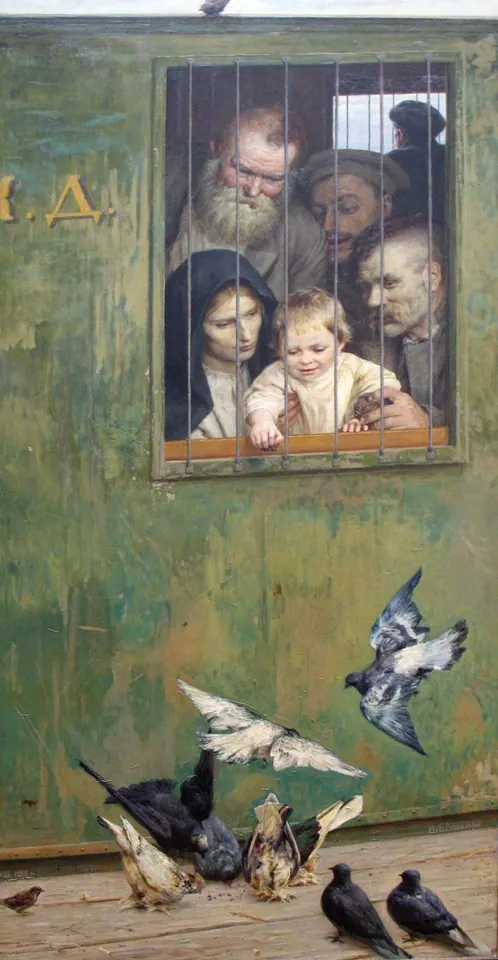
In 1888 Yaroshenko depicted people at the window of a prison railway car. A mother holds a child feeding pigeons. The artist knew members of the populist movement and sympathised with their ideas. His audience lived amid public debates about exile and the treatment of prisoners.
The child reaches between the bars towards pigeons on the platform. The grille crosses the faces, remaining visible even within this small everyday action.
The writer Stefania Karaskevich posed for the mother. Her blue head covering and the child in her arms recall traditional Madonnas, a comparison also made by the Tretyakov Gallery.
An older man leans towards the same window. Yaroshenko gathers people of different ages and social positions. Their faces appear at almost the same level, over one another’s shoulders.
A figure farther back turns towards another window. This small opening reveals the width of the carriage behind the group crowded at the bars.
Pigeons peck at crumbs on the platform. The lower part of the tall canvas is given to boards and birds, placing the window above the viewer.
One pigeon flies up towards the window. Its wings stand out against the solid green wall occupying much of the painting, making the side of the carriage feel large.
According to Karaskevich’s recollections, stories by Leo Tolstoy influenced the conception. Yaroshenko chose an everyday episode through which viewers could recognise prisoners’ attachments and familiar feelings. Pavel Tretyakov acquired the painting that year.
- Medium
- Oil on canvas
- Collection
- State Tretyakov Gallery
- Dimensions
- 213.7 × 107.5 cm
- Accession number
- 701
Sources
Public domain. Reproduction from Wikimedia Commons. Image licence