The School of Athens
Raphael · 1508–1511 (Stanza della Segnatura cycle)
Explore the painting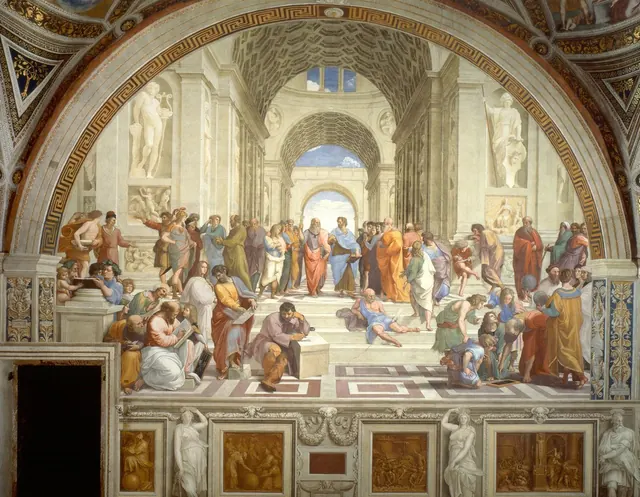
Raphael gathered ancient philosophers in a room used as Pope Julius II’s library and study. Its murals presented philosophy, theology, poetry and law as related fields of knowledge. The School of Athens brings thinkers from different periods into one imagined space. Such a gathering never happened. It expresses the early sixteenth-century papal circle’s understanding of the ancient inheritance.
Plato holds the Timaeus and raises a finger. Aristotle beside him carries the Ethics and extends a hand forwards. The books identify them, while their gestures distinguish ways of thinking. These are often summarized as attention to ideas and to earthly experience. That can begin a discussion, but neither philosopher’s thought can be reduced completely to one hand movement.
The two philosophers walk at the same level and share the centre. No barrier separates them. Raphael presents difference within conversation, while surrounding groups argue, read and explain. The papal library incorporates ancient philosophy into its own system of knowledge. A religious commission here provided space for depicting pre-Christian thinkers.
In the foreground, a man writes while leaning on a stone block. The Vatican Museums identify him as Heraclitus with Michelangelo’s features. Michelangelo was then working in the nearby Sistine Chapel. A contemporary artist joins the ancient philosophers. This connection allows discussion of painting’s claim to intellectual status: work performed by hand appears beside celebrated activities of the mind.
On the right, pupils bend over Euclid’s geometrical demonstration. Heads and hands point towards one small area. One person looks closely; another turns to a neighbour. Learning appears as a shared examination of something visible. Raphael distributes attention between people and an object of study, giving the abstract idea of knowledge a concrete bodily setting.
Arches recede, and steps distribute activities across different levels. The architecture recalls Bramante’s Renaissance designs for Saint Peter’s. An imagined ancient school receives the forms of Raphael’s contemporary Rome. It is no archaeological reconstruction of Athens. Ancient learning is connected with the architectural ambitions of the commission’s own time and place.
Near the right edge, Raphael included his self-portrait in a black beret. He looks towards us among people engaged in discussion. His presence can act as a signature and as a statement about the artist’s place within learning. It also recalls who assembled this imagined circle. The selection belongs to a particular culture deciding whose inheritance to make visible.
The scene’s harmony does not erase differences between the doctrines represented. It offers an image of coexisting knowledge for a papal study. We can admire that broad gathering while asking whom its selection leaves outside the wall. The School of Athens becomes fuller when seen both as many independent activities and as a commissioned image of intellectual order.
- Medium
- Fresco
- Collection
- Vatican Museums
Sources
Reproduction of a public-domain artwork. Image licence