The Tribute Money
Masaccio · 1423–1427 (initial Brancacci Chapel cycle)
Explore the painting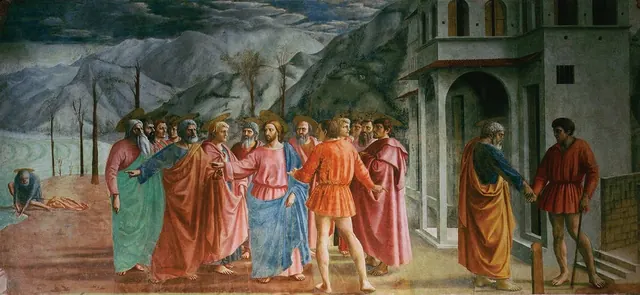
Three moments from the Gospel of Matthew appear together. A temple tax is requested from Christ and Peter. Christ instructs Peter to take a coin from a fish’s mouth and pay for both of them. Masaccio painted the story in the Florentine Brancacci family chapel in the 1420s. The patron Felice Brancacci was a merchant. Money spent on church painting meets a Gospel story about payment in the same room.
Christ stands at the group’s centre and points left. Peter repeats the gesture. The other apostles form a close semicircle, so the direction emerges from the gathering and leads us to the next episode. Masaccio provides a clear route without captions or separate frames. We first encounter a demand and its answer, then follow the extended hands.
The collector stands with his back to us. His short orange clothing exposes his legs and differs sharply from the apostles’ long robes. He occupies the interval between us and Christ. The dispute over payment acquires a physical form: two worlds confront each other in a small space. Yet Christ does not remove the demand by force. The story will end with an actual coin changing hands.
At left Peter crouches beside the fish, with his orange outer garment nearby. His body is small because the episode is set further away. The miracle occupies very little space. It belongs within a chain of instruction and fulfilment. This choice directs attention towards people’s actions rather than a separate spectacle of supernatural power.
At right Peter hands the coin to the collector beside a building. His blue-green garment and orange cloak identify the same person who stands beside Christ and bends towards the water. The collector also appears twice. Characters exist repeatedly on one wall. This is not a perspective mistake but a way of seeing time together, keeping cause and result connected.
Shared mountains and light hold the episodes within one world. Bodies cast shadows and possess weight. The central group’s feet and the nearby building’s vertical edge help us imagine ground and distance. The early Renaissance changes the persuasive force of a religious story through spatial construction. Sacred history gains a setting in which we can mentally stand beside its participants.
The Brancacci family’s later political defeat led to the removal of portraits associated with them from the chapel’s paintings. Commissioning church art preserved a family’s name and standing, but that memory depended on Florentine power struggles. The wall can therefore be read on two levels. It tells Peter’s story while showing private wealth taking public religious form. The chapel’s subsequent history reveals that alliance’s vulnerability.
- Medium
- Fresco
- Collection
- Brancacci Chapel, Santa Maria del Carmine, Florence
Sources
Reproduction of a public-domain artwork. Image licence