The Threshing Floor
Alexey Venetsianov · 1822–1823
Explore the painting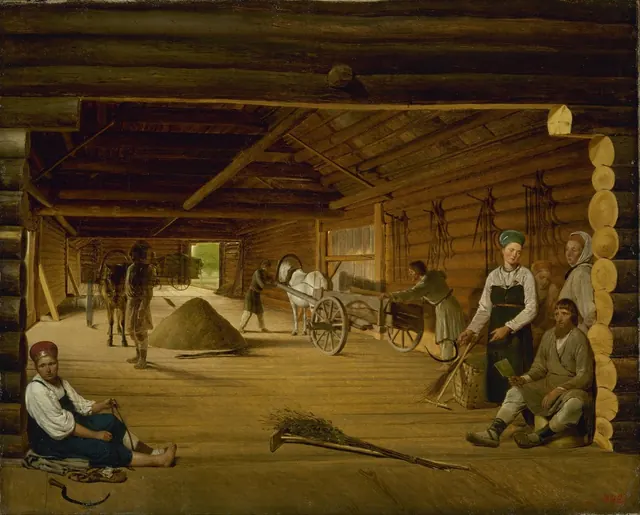
This painting began with someone else’s interior. At the Hermitage, Venetsianov spent long periods studying François Granet’s painting of a Roman monastery. He was interested in depth and light. Back on his estate, he chose a grain-processing barn for a comparable experiment. A peasant building would stand comparison with the work of an established European painter.
To paint from life, Venetsianov had the front wall of the actual barn cut away. Light gained another entrance and the artist an unobstructed view. Log ends remain conspicuous at the right edge. This carefully studied place had been physically altered for the picture. The scene’s apparent naturalness was the result of preparation.
Ceiling beams and side walls converge into the distance. This is linear perspective: parallel lines draw closer together in the image as they recede. Venetsianov explores it within a long, low building. We can follow the space from the heavy beam overhead to the small bright opening at the back.
Light at the back doorway almost bleaches the floor. A side opening illuminates the cart and white horse while deep shadow remains beneath the roof. Different wooden surfaces take on different tones. Several sources of daylight can be distinguished within the same room, rather than the whole building receiving uniform illumination.
The woman at the left sits close to us. Farther back a man leads a horse; smaller figures stand near another cart beyond him. Their changing size measures the space. Their poses also allow faces and clothing to be studied. Everyday workers occupy the foreground, where a painting’s principal figure is usually most easily distinguished.
Women stand at the right beside a seated man holding a wooden scoop. A woven container and long tools rest near their feet. People and equipment establish the barn’s working function, although the painter does not show unbroken strenuous labour. Some figures are occupied and others have paused. Their arrangement makes each available for separate attention.
Wooden tools lie across the floor beside plant material. Their long shapes cross the broad boards, while the cartwheels above turn at different angles. These ordinary objects demand precise drawing and help describe the room. The equipment of a working farm supplied the artist’s experiment in perspective.
Venetsianov owned an estate with serfs, and his models included peasants dependent on him. This changes the question we might ask about the picture’s calm. Rural life appears in a form selected by its landowner and painter. The arrangement of figures cannot establish how the workers themselves understood their labour or status. Attention to the individual needs to be considered alongside the inequality between model and artist.
Venetsianov taught students from serf and townspeople families. They lived with him, painted familiar interiors, people and landscapes, and some gained freedom with his help. Direct observation offered an artistic education to people for whom entry into the art world was difficult. At his school, rural life could also be depicted by artists who came from that world.
In 1823 Venetsianov wrote of wanting his barn to hang in the Hermitage beside Granet. In spring 1824 Alexander I acquired it for 3,000 rubles. A peasant interior entered the imperial collection. The painter could take pride in its space and light; viewers encountered a representation of rural life. How far did this calm, carefully arranged world bring them closer to the experience of the people depicted?
- Medium
- Oil on canvas
- Collection
- State Russian Museum
- Accession number
- Ж-5154
Sources
Reproduction: Wikimedia Commons · Public Domain