The Trinity
Andrei Rublev · Probably 1422–1427
Explore the painting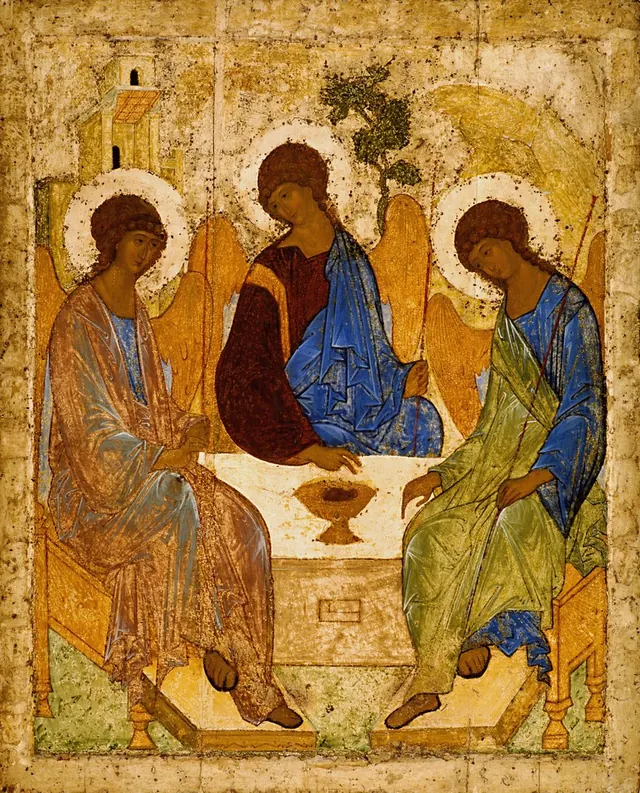
Rublev painted the Trinity for the monastery of Sergius of Radonezh, probably in the 1420s. The commission is associated with Abbot Nikon’s commemoration of his teacher Sergius. The icon belonged to a community that gathered for worship. Its purpose explains the painter’s unusual task: to express God’s unity through three separate figures while preserving the distinction between them.
The subject comes from the biblical account of Abraham’s three visitors. He offers them rest and food, then learns that a son will be born. Christian tradition interpreted the encounter as a revelation of the Trinity. Rublev omitted the hosts and the preparation of food. The gathering at the table concentrates its meaning in the angels and the cup.
The cup contains a calf’s head. The food retains a connection with Abraham’s hospitality, while a Christian reading links it with Christ’s future sacrifice. The middle angel’s hand points towards the cup; neighbouring hands continue the movement around the table. A small object gathers the attention of the three figures and the viewer. A light tabletop and the space around it make it stand out.
The heads incline differently, but all three angels have similar faces, haloes and ochre wings. Their outer contours approach a circle. The eye can follow a bowed head, shoulder and sleeve towards the next angel. Repetition conveys equality; their coordinated arrangement conveys unity. A complex theological idea acquires a visible form.
Blue recurs in all three figures’ clothing. In the middle it lies beside dark reddish brown; on the right beside light green; on the left it appears beneath golden folds. A shared colour connects different combinations. Fine light lines describe folds, while broad coloured areas remain clear at a distance. Each figure is distinct within a common palette.
The tree behind the middle angel recalls the grove of Mamre, the setting of the biblical encounter. Its dark crown occupies a small part of the light background. The trunk rises beside the bowed head, with branches spreading above it. Rublev retains enough landscape to preserve the narrative connection and leaves almost the entire surface to the figures.
A small building with dark openings stands on the left. Walls and roof are distinct, yet it appears too small for the figures below. The footrests also turn at different angles. Objects remain recognisable without a single vanishing point. They indicate the setting and the bodies’ positions while keeping the religious image clear.
The feet rest on narrow supports. Light gaps separate them from the front of the table, preventing the lower part from becoming a solid mass. Long garment edges guide the eye back towards hands and faces. The composition’s stillness grows from chosen distances and gradual transitions between its parts.
In 1551 the Council of a Hundred Chapters named Rublev among the masters painters should follow when depicting the Trinity. An individual solution became an authoritative model. This raises a question about freedom within tradition. A painter could change details and relationships to express a shared doctrine more clearly; later generations learned from his work. Religious patronage both set boundaries and supported that exploration.
For a long time a precious metal covering concealed much of the painting. In the early twentieth century restorers uncovered the colours beneath later layers. This is also a history of different ways to preserve and honour one object. Donors adorned the sacred image with gold, hiding parts of its design; conservators revealed the paint and returned attention to the brushwork. What we value in an icon changes how we want to see it.
- Medium
- Egg tempera on wood
- Collection
- Made for Trinity Cathedral, Trinity–Sergius Lavra
- Accession number
- ГТГ / Tretyakov: 13012
Sources
Public Domain. Resized previews and tiles prepared for display; no retouching or upscaling. Image licence