Breezing Up (A Fair Wind)
Winslow Homer · 1873-1876
Explore the painting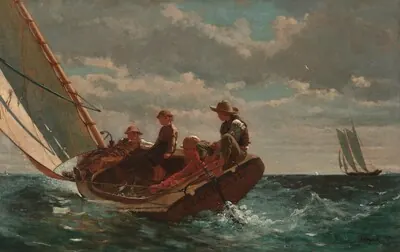
A boy controls the tiller of a small boat. Homer revised the arrangement, replacing one figure with an anchor. At the 1876 Centennial Exposition, critics associated the anchor and the child's forward gaze with hope for America's future after the Civil War. An everyday sailing scene received a national interpretation from its first audiences.
People sit close together in the small boat. Their inclinations follow the hull's movement under sail.
A boy sits beside the tiller and steers. His forward attention became important to the painting's early interpretation.
A pale sail cuts into the sky. The broad taut cloth conveys the wind moving the boat.
A distant vessel carries narrow sails. It establishes distance beyond the close foreground group.
The bow rises above choppy green water. Its position shows both the waves' movement and the small boat's response.
At the United States centennial exhibition in 1876, critics read the boat as a sign of hope for the country’s future. This interpretation reflected postwar expectations. Homer, who had worked as an artist-correspondent during the war, was increasingly turning to life by the sea.
- Medium
- oil on canvas
- Collection
- National Gallery of Art, Washington
- Dimensions
- Overall, 61.5 × 97 cm
- Accession number
- 1943.13.1
Sources
Reproduction of a public-domain artwork. Image licence