Evening bell from mist-shrouded temple (left); Autumn moon over Lake Dongting (right)
Unidentified painter in the style of An Gyeon · ca. 1450–1500
Explore the painting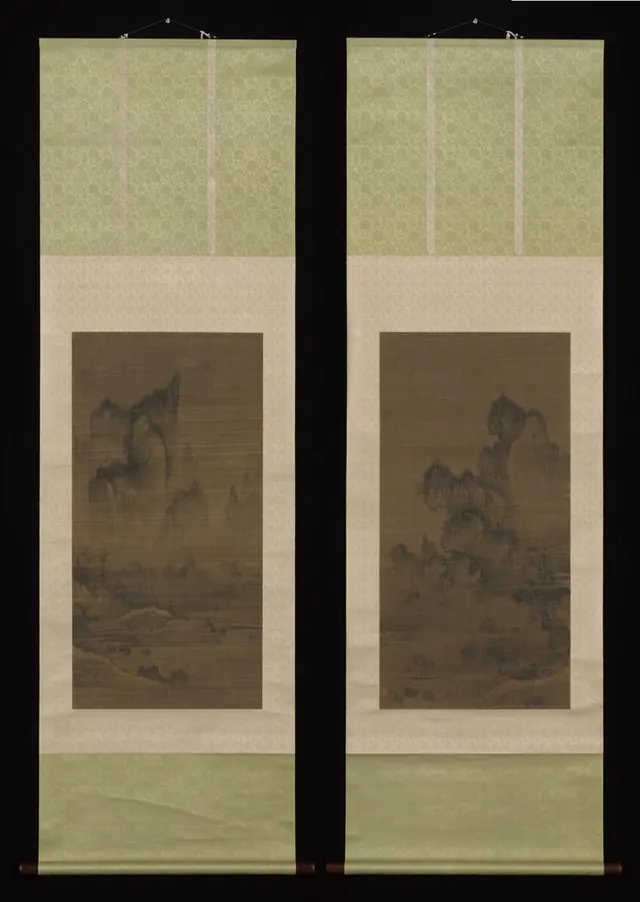
Two Korean scrolls concern places in China familiar to educated viewers through literature. On the left is Evening Bell from Mist-Shrouded Temple; on the right, Autumn Moon over Lake Dongting. They probably belonged to an Eight Views of the Xiao and Xiang Rivers cycle. Their titles establish times and circumstances that paint does not show completely.
Mountains rise in several stages in the left scroll. Pale intervals divide their masses, while distant parts lose definition in mist. The painter uses varied ink tones and soft washes. The silk itself remains part of the luminous medium in which the mountain forms appear.
Buildings of a temple complex can be distinguished beneath the mountains. The title names an evening bell, but no close-up singles out the sound’s source. Reading the title adds an imagined sound to the still view. A literary designation expands the image without requiring everything to be represented literally.
Small dark foreground forms sit among broad pale intervals. They indicate the near shore and help establish the mountains’ distance. Unfilled areas perform specific spatial work, separating banks and concealing the continuation of slopes.
In the right scroll a tall mountain group is shifted to one side. Its projections resemble rounded cloud masses. These forms, and the interplay of solid areas with voids, belong to the manner of An Gyeon, a leading fifteenth-century Korean landscapist. The scrolls are unsigned, so the museum retains the designation “style of An Gyeon.”
A pale shore appears in the lower part of the right scroll. No lunar disc is shown, although the title names the moon. Pale water and mountains permit a nocturnal reading, but without the title a viewer might identify a different time of day. Understanding the landscape depends substantially on its inherited subject.
The scrolls are displayed together, but each has its own mounting and independent space. They do not join into one continuous shoreline. Comparison works through recurring mountains, water, trees, and mist, as well as through different poetic circumstances.
Chinese literary landscapes of this kind remained popular in early Joseon Korea. They can be understood both as engagement with a shared cultural tradition and as an independent Korean transformation of it. Exact location is less securely established here than the sources of the titles and artistic manner.
- Medium
- Pair of hanging scrolls; ink on silk
- Collection
- The Metropolitan Museum of Art
- Dimensions
- Image (each), 89.9 × 45.4 cm
- Accession number
- 1987.278a, b
Sources
Image provided under CC0. Image licence