Portrait of a Woman with a Man at a Casement
Fra Filippo Lippi · ca. 1440
Explore the painting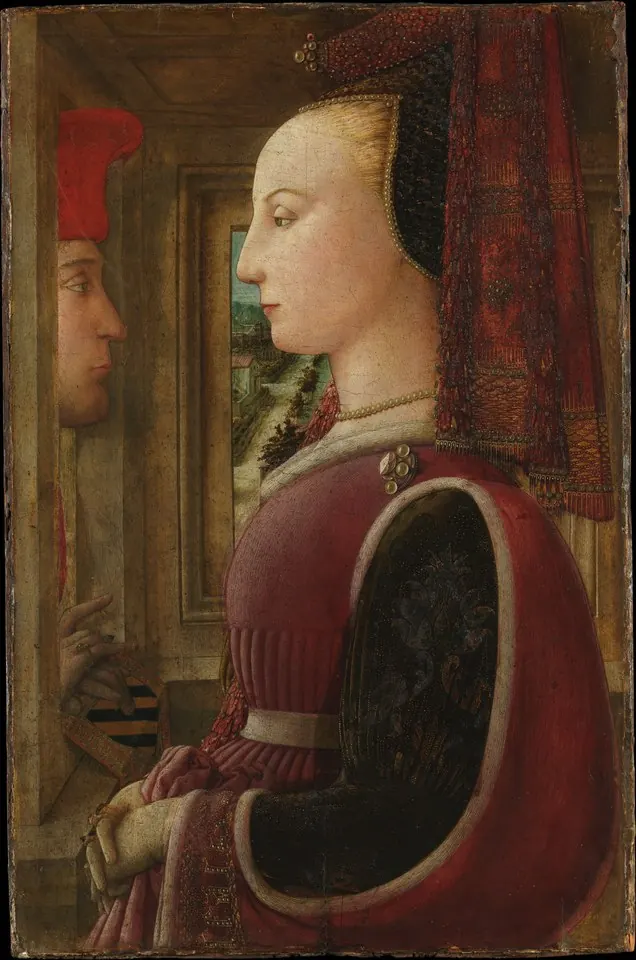
A woman occupies most of the room, while a man appears only in a side window. Filippo Lippi painted this unusual pair around 1440. It is considered the earliest surviving Italian double portrait and among the first portraits set in a domestic interior. The room’s arrangement describes the relationship between two people: one is presented for close inspection, while the other watches from the edge.
The woman turns in strict profile. Her high forehead, coiffure, jewelry, and rich cloth form a clearly outlined silhouette. This pose is especially suited to displaying a social identity. Clothing and bearing are almost as legible as facial features. Individual likeness coexists with an idea of how a respectable woman from a prosperous household should appear.
Pearls and the elaborate headdress belong to costly dress that the museum associates with French fashion. Such possessions participated in family representation. A portrait preserved the visibility of wealth beyond a single outing or ceremony. Displayed at home, it made the woman’s appearance part of the household’s memory and reputation.
The sleeve bears the embroidered word lealtà, loyalty. It states a moral expectation alongside material splendor. The woman is represented through qualities valued in marriage. Yet the viewer learns little about her own activities. Elaborate dress and an explicit virtue coexist with silence about much of an individual life.
The man at the left looks into the room beside a coat of arms associated with the Scolari family. The couple’s identities remain debated. The Met proposes Lorenzo Scolari and Angiola Sapiti, married in 1436, as possible sitters. Under that identification, the portrait would connect a newly formed household with the Scolari family’s prestige. The sitters’ exact identities remain unestablished.
Another window behind the woman opens onto a small distant landscape. The two openings serve different purposes. One admits the man’s gaze; the other reveals space beyond the room. The woman remains between these directions and does not meet the viewer’s eyes. Lippi’s spatial experiment creates a domestic setting while assigning the roles of observer and observed.
The woman occupies most of the painting, yet the inscription on her sleeve chiefly states the loyalty expected of her. The man appears only at a window beside the family arms. Size alone therefore does not explain each person’s position. The double portrait lets us compare what the painter tells us about them—appearance, virtue and family—and what remains unknown.
- Medium
- Tempera on wood
- Collection
- The Metropolitan Museum of Art
- Dimensions
- 64.1 × 41.9 cm
- Accession number
- 89.15.19
Sources
Image provided under CC0. Image licence