The Last Communion of Saint Jerome
Sandro Botticelli · early 1490s
Explore the painting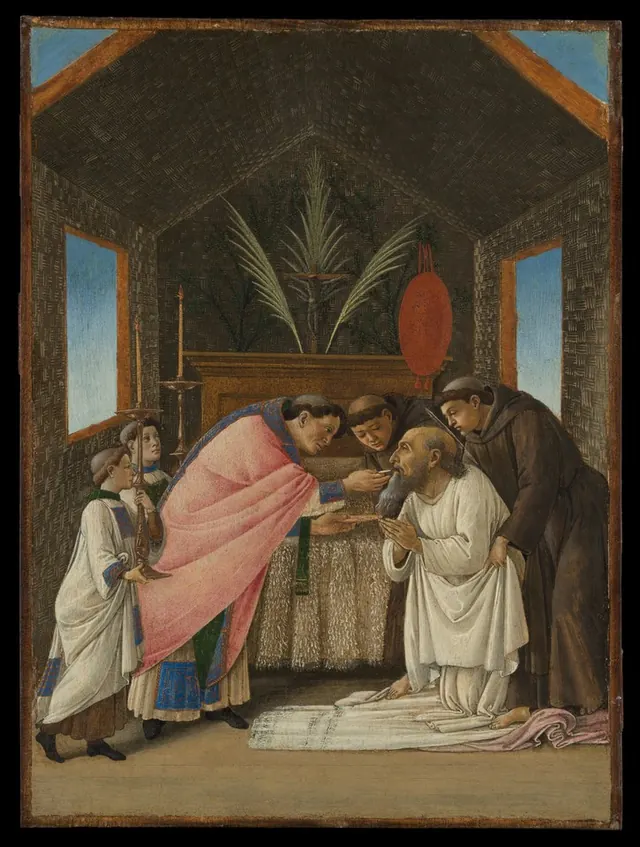
The aged Jerome kneels to receive his final communion. Brothers support his weakened body as a priest offers the host. Botticelli painted this small work in the early 1490s for the Florentine wool merchant Francesco del Pugliese, a supporter of Savonarola and an opponent of the Medici. A devotional image emerged within the city’s tense political life.
Jerome, dressed in pale clothing, raises his joined hands. His knees bend and his body requires support from behind. He performs little independent movement. Other people carry much of the action, helping him participate in the sacrament. The religious event joins the recognizable need to care for someone approaching death.
The small pale disk of the host lies between priest and saint. Almost lost among the hands, it directs the entire gathering. In Catholic communion, the bread is understood as Christ’s body. A modest movement of the hand therefore forms the painting’s meaningful center, outweighing more conspicuous fabrics and architecture.
Two young attendants holding candles stand at the left. Candle verticals and elongated figures establish the ceremony’s measured arrangement. Repetition does not make the participants identical. Their heads turn toward the event, while their hands perform different actions. Even in the confined room, Botticelli preserves a distinct place for each attendant.
A crucifix hangs at the back, connecting Jerome’s final communion to Christ’s sacrifice, the sacrament’s foundation. A bed and simple furnishings appear behind the figures. The setting is a cell near Bethlehem. Solemnity emerges within modest living quarters, without a large church or public gathering.
A red cardinal’s hat appears behind Jerome. European painters used it as a recognizable attribute, although he lived in the fourth and fifth centuries, long before that form of cardinal’s dress. Sacred history was represented through signs familiar to later viewers. The scholar associated with the Latin Bible acquires a visible place within the image’s ecclesiastical hierarchy.
A Florentine merchant could turn to this scene in private devotion. His wealth paid for an image valuing humility, assistance, and the acceptance of death. The patron’s politics add another dimension. Botticelli’s art operated among competing Florentine groups and interests, and a religious commission could accompany opposition to the city’s most influential family.
- Medium
- Tempera and gold on wood
- Collection
- The Metropolitan Museum of Art
- Dimensions
- 34.3 × 25.4 cm
- Accession number
- 14.40.642
Sources
Image provided under CC0. Image licence