Terracotta amphora (jar)
Attributed to Berlin Painter · ca. 490 BCE
Explore the painting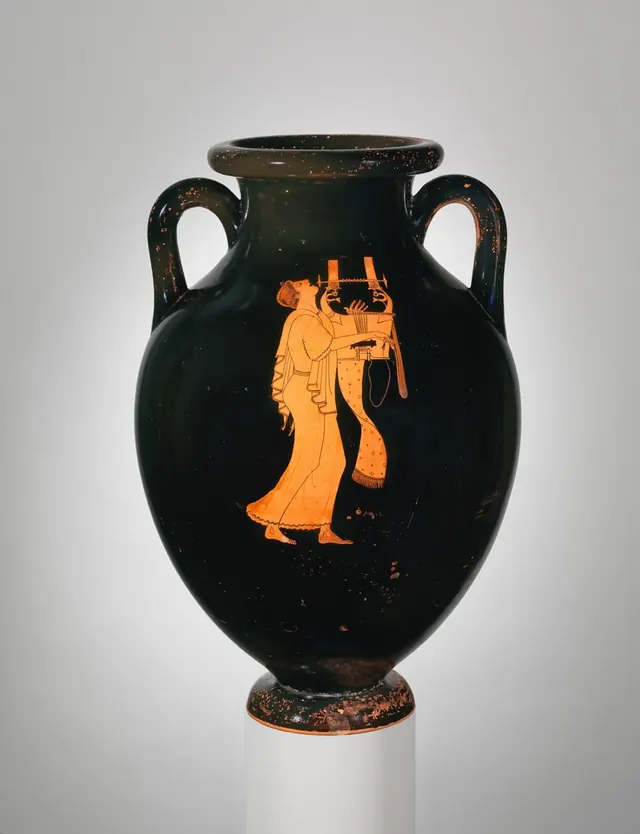
A young man sings while playing the kithara. A judge appears on the other side of the amphora, suggesting a musical competition. An Athenian painter decorated the vessel around 490 BCE. Performance met public judgment in such contests, while finely painted pottery preserved an image of the occasion beyond the festival itself.
The singer raises his chin and opens his mouth. The line of his neck continues the movement of his body. A black field replaces a crowd or architectural setting. One performer occupies nearly all the available space on the curved vessel. Turning the amphora would change both his outline and his relationship to the judge on the reverse.
The kithara was a wooden-bodied string instrument used in public performance, including the recitation of epic poetry. Its tall frame nearly reaches the musician’s head. One hand rests near the strings while the other extends across the instrument. The pose combines the singer’s effort with the instrumentalist’s work.
Fine folds cover the musician’s long garment. The reddish figure retains the clay’s color while the background carries a black coating. This is red-figure painting. A brush could describe details within the silhouette, varying line thickness to render cloth. Here the folds help distinguish the legs beneath the garment.
A patterned textile hangs from the kithara, its dense ornament differing from the garment’s long folds. The fringed end curves aside, extending movement beyond the musician’s body. Strings, hanging cloth, and the elongated silhouette form parallel lines across the vessel’s curved wall.
The feet emerge from the long garment into the surrounding black field. The painter supplies neither steps nor a large theater. The interpretation as a competition depends chiefly on the reverse, where dress and a staff identify the judge. A single photograph removes that part of the story and can make a public performance resemble private music-making.
Performer and judge occupied opposite sides of the same vessel. Skill in voice and instrument mattered, but recognition also depended on another person’s decision. Today the singer is frequently reproduced alone. The image of music remains familiar, while the person who judged it has largely dropped out of the amphora’s usual presentation.
- Medium
- Terracotta
- Collection
- The Metropolitan Museum of Art
- Dimensions
- Height, 41.50 cm
- Accession number
- 56.171.38
Sources
Image provided under CC0. One view of a painted object. The reverse is not shown. Image licence