Terracotta neck-amphora (jar) with lid and knob (27.16)
Attributed to Exekias · ca. 540 BCE
Explore the painting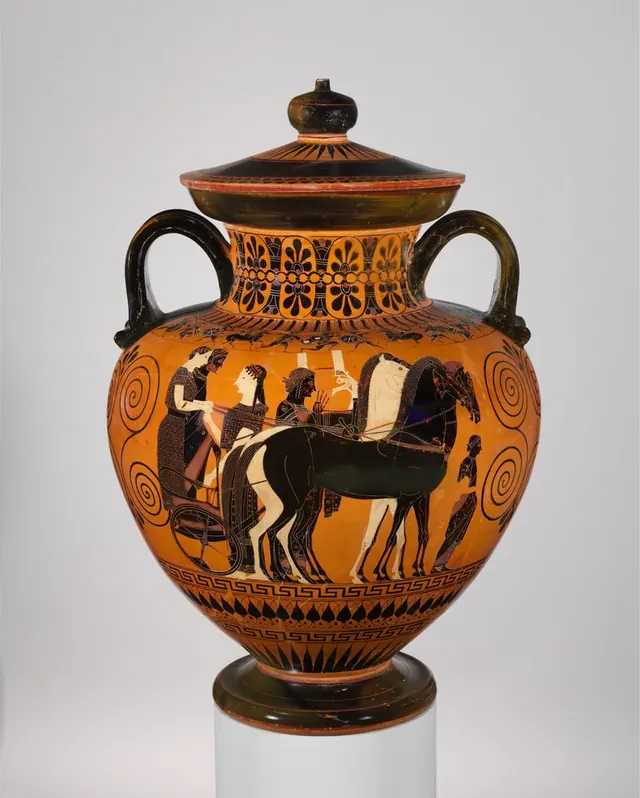
The amphora’s decoration covers its rounded body, narrow neck, shoulder, and lid. An Athenian maker of the mid-sixth century BCE chose a different scale of design for each surface. The museum attributes the vessel to Exekias, who worked as both potter and painter. It shows the close relationship between an object’s shape and its painted decoration.
A man and woman stand in the chariot, accompanied by another woman and a kithara player. The museum record does not securely identify them as particular gods or heroes. Their uncertain identities do not prevent us from recognising the scene’s formal arrangement: a chariot couple, attendants, and music.
The horses overlap closely. Parallel legs and fine harness lines distinguish several animals within the dense group. The painter accommodates the amphora’s curvature: the action runs along its widest area, where figures can be large. Turning the vessel revealed further decoration.
Tiny checks and patterns cover the figures’ clothing. In black-figure technique, the painter applied dark silhouettes and incised details into them. After firing, the lines exposed the clay’s colour beneath the coating. White for female skin and additional areas of colour expanded the technique’s range.
A second, much smaller row of figures runs around the sloping shoulder. Foot soldiers and horsemen fight here. The space between the neck and the principal scene becomes an additional band. Its small scale accommodates a sharply curving surface that would be awkward for large figures.
Plant motifs alternate around the neck. Their vertical design suits its narrow upright surface. Large scrolls beside the handles separate the human scene from the sides. Ornament distributes the decoration across the vessel and maintains clear boundaries between episodes.
The lid survives with the amphora. Bands circle it, while the small knob above remains mostly dark. Decorated and plain areas alternate from bottom to top. Even surfaces without figures contribute to the object’s overall arrangement.
Without the participants’ names, the scene allows different hypotheses about its meaning. Yet resemblance to a familiar myth needs testing against additional clues. The amphora makes a useful distinction between what is securely visible—a chariot, a couple, music—and what the decoration alone does not establish.
- Medium
- Terracotta
- Collection
- The Metropolitan Museum of Art
- Dimensions
- Height, 47 cm
- Accession number
- 17.230.14a, b
Sources
Image provided under CC0. One view of a painted object. The reverse is not shown. Image licence