At the Seaside
William Merritt Chase · ca. 1892
Explore the painting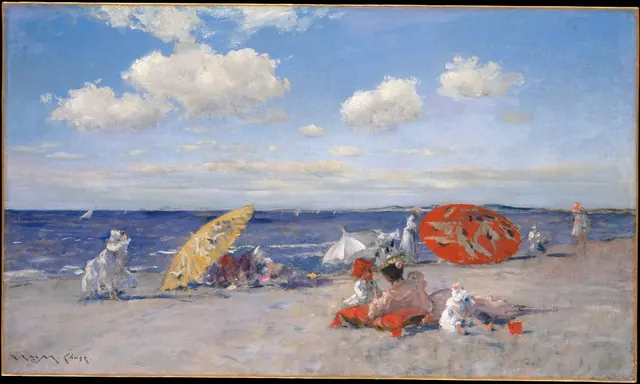
William Merritt Chase painted this shore around 1892, shortly after his summer art school opened at Shinnecock Hills on Long Island. He directed it from 1891 to 1902. Classes took place outdoors among the shores and dunes that also supplied subjects for his paintings. Teaching occupied two days a week, leaving time for his own work and family.
Women and children occupy the broad sandy shore at different distances from the water and one another. Chase leaves substantial open areas between groups. Leisure appears through the freedom to choose a place and an activity without urgency. No single incident commands the attention of everyone present.
A yellow parasol at the left stands out against the water. Its color draws attention to a small group described with a few light and dark strokes. Such relationships matter in outdoor painting. Forms remain distinct in bright light even though clothes, faces, and shadows receive little fine detail. Chase holds the impression of the entire shore together with individual accents.
At the lower right, a woman in pink sits near a child, with a red pail nearby. The small object connects the landscape to children’s play. Adults share this shore with children, and their clothing and parasols belong to the culture of summer outings. The title provides no names; the organization of leisure matters more here than identifying every figure as a member of the painter’s family.
Sails near the horizon make distance measurable. Broad bands of water and sand separate them from the foreground figures. Yet the coast’s development has another history. In his commentary for the Met, Shinnecock artist Jeremy Dennis points out that the school stood within his people’s ancestral territory. He connects resort development with dispossession, including an illegal land transaction in 1859.
A distant red parasol repeats a bright foreground accent. This appealing summer view belonged to an area becoming a resort. Dennis explains that the arts patron Janet Hoyt proposed Chase’s teaching position as part of a plan for real-estate development and summer tourism. The school, the area’s artistic reputation, and land values reinforced one another. Coastal beauty could become part of its commercial appeal.
Chase presented the shore through the experience of holidaymakers. Jeremy Dennis’s commentary brings back the Shinnecock people’s history and struggles over land. His account places the summer school and resort within a much longer coastal history. We can still notice light, sails and loose brushwork while asking whose life this view makes visible and whose it leaves outside the frame.
- Medium
- Oil on canvas
- Collection
- The Metropolitan Museum of Art
- Dimensions
- 50.8 × 86.4 cm
- Accession number
- 67.187.123
Sources
Image provided under CC0. Image licence