Improvisation No. 30 (Cannons)
Vasily Kandinsky · 1913
Explore the painting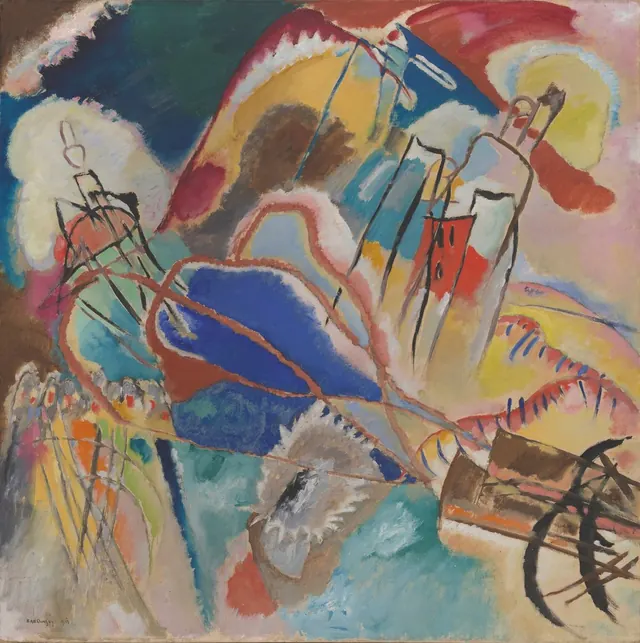
Kandinsky painted Improvisation No. 30 in Munich in 1913. Individual objects remain recognisable among coloured patches. Lines can cross colour without following its edge, as forms begin to operate independently of depicted objects.
The cannons at the lower right give the painting its subtitle. In a letter to collector Arthur Eddy, Kandinsky connected their appearance to talk of war. The work predates the First World War by a year.
Black lines on the right suggest roofs and walls. Red and pale areas sometimes extend beyond them. Colour does not simply fill the outlines of each object.
A broad blue shape curves through lighter paint. Its size, direction and neighbouring colours can be examined without assigning it the name of an object.
On the left, thin black lines cross broad red ones. Smooth curves give way to abrupt turns. Changes in thickness and direction make the brush’s movement visible.
A red band curves above a pale yellow area. Its edge is broad and soft in some places, narrower in others. Here the direction of the coloured brushstroke can be followed independently of the thin black lines.
Near the bottom, blue paint meets white openings and short dark strokes. This area is less dense than the blue patch above. Differences in saturation and paint density separate parts of the painting without relying on object outlines.
This work marks a stage in Kandinsky’s move towards abstraction. The title still identifies cannons, but much of the painting depends on relationships of colour and line. Every passage need not be decoded as a hidden object.
- Medium
- Oil on canvas
- Collection
- Art Institute of Chicago
- Accession number
- 1931.511
Sources
Open-access Art Institute of Chicago reproduction, CC0. Image licence