Funerary Portrait of a Young Girl
Unidentified painters of Roman Egypt · c. 25–37 CE
Explore the painting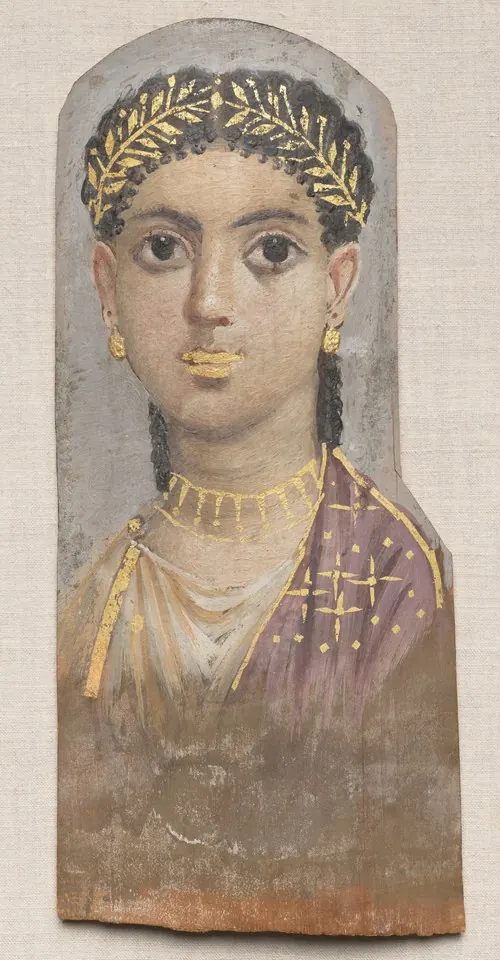
Gold covers the girl’s lips, like the wreath and jewellery. The portrait was intended for burial in Egypt under Roman rule. Her hairstyle helps date it to approximately 25–37 CE. The face follows Greco-Roman pictorial traditions, while the image belonged to mummification practices. Two ways of representing a person met in a small object meant to accompany its subject after death.
Large eyes look outwards. Small highlights give them moisture, while shadows beside the nose lend the face volume. The image feels like the presence of someone able to return our gaze. Such vitality had a particular purpose in a funerary setting. A recognisable face persisted where the physical body was concealed beneath wrappings.
Dark curls frame the forehead, with long strands descending on both sides. The hairstyle belongs to fashions late in Tiberius’s reign. Even a funerary image preserves a person in contemporary appearance. Within ancient religious practices remain signs of changing time: how people arrange hair, choose clothes and wish to appear to others.
Golden lips stand apart from the skin differently from an ordinary highlight. Metal does not model the mouth’s volume; it changes its substance within the image. The Cleveland Museum connects such gilding with the deceased’s possible transformation into an akh, an effective spirit. A familiar face acquires a quality beyond the mortal body. Gold makes that transition visible on the portrait’s surface.
The necklace and earrings continue the golden accents below the face. Pale clothing and purple fabric appear beside them. Jewellery conveys prosperity and a carefully chosen appearance. Its brilliance could express earthly standing and a desired posthumous condition simultaneously. One detail sustains memory of a lived life and hope for its continuation in another form.
Towards the lower edge the image thins, exposing its linden-wood support. Pigments are mixed with wax, a technique called encaustic. Small brush marks remain on the face, while the metal wreath forms flatter areas. The portrait combines soft transitions of skin with gold’s sharp brilliance. Different materials serve different purposes, from bodily likeness to a sign of transformation.
Today the separate panel almost resembles a familiar portrait for a wall. Its former attachment to a mummy changes the encounter’s meaning. The image participated in care for a particular deceased person’s fate. Contemporary fashion and ancient ritual did not displace one another. The girl could appear part of Greco-Roman society while remaining within Egyptian religious traditions after death. Her portrait shows cultures coexisting in one human image.
- Medium
- encaustic on linden wood
- Collection
- Cleveland Museum of Art
- Dimensions
- Overall, 39.4 × 17.4 cm
- Accession number
- 1971.137
Sources
Image provided under CC0. Image licence