Landscape
Sōami · early 1500s
Explore the painting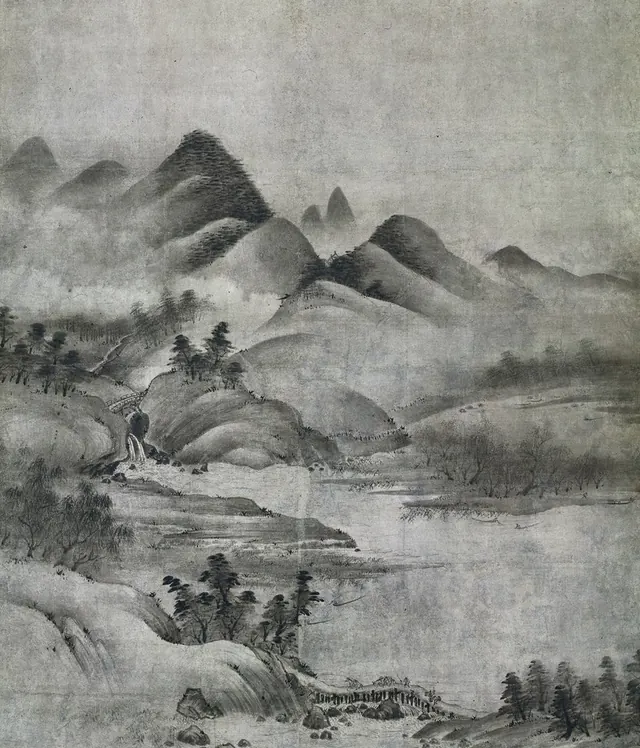
Slopes emerge from mist as tiny people cross water on a bridge. Soami painted this landscape in the early sixteenth century as part of a much wider composition. Today’s hanging scroll once belonged to a folding screen. After the screen was divided, the section was trimmed and remounted for hanging. Its apparently complete space preserves only part of a world that formerly surrounded viewers in a room.
A great mountain takes shape through soft washes and short dark strokes. Its outline disappears in places, allowing air into the silhouette. Soami served as curator of the Ashikaga shoguns’ collection and studied its Chinese paintings. Working with that collection gave him access to different brush methods. A soft, moist manner is especially important here.
At the left, water falls through a narrow gorge. White streams appear between dark rocks and continue as small ripples. Brush movement changes with the water’s condition. A brief noisy passage occupies a broad calm space. This variation gives the landscape sensory richness despite an almost complete absence of colour.
The lower bridge bends above a stream. Travellers on it establish the scale of surrounding slopes. Their movement crosses the painting, continuing a route that could connect neighbouring screen sections. Once the fragment was separated, the bridge became an apparently independent entrance into the landscape. The object’s history changed how the eye enters its image.
Trees on the near bank are painted in dense ink. A few assured touches form their crowns above much thinner trunks. Similar marks in the distance shrink to dots. Repeating one method at different scales creates depth. The brushmark remains visible while becoming vegetation on a slope.
Pale water occupies much of the right half. Banks emerge in separate bands and disappear again. Open surface lets the mountains appear as volumes separated by distance. Soami adapted small Chinese album leaves and handscroll compositions into large paintings for residences and temples. Such landscapes occupied entire walls and screens.
Another part of the composition survives in Kyushu, Japan. Division allowed individual sections to continue existing but changed the landscape’s original extent. That history complicates the present scroll’s beauty. Its independence arose through the loss of a whole. Attention to the trimmed space restores painting’s role within an interior and the viewer who moved before it.
- Medium
- hanging scroll; ink on paper
- Collection
- Cleveland Museum of Art
- Dimensions
- Image, 128.5 × 111.7 cm
- Accession number
- 1963.262
Sources
Image provided under CC0. Image licence