Mural Fragment with Elite Male and Maguey Cactus Leaves
Unidentified Teotihuacan painter · 500–550
Explore the painting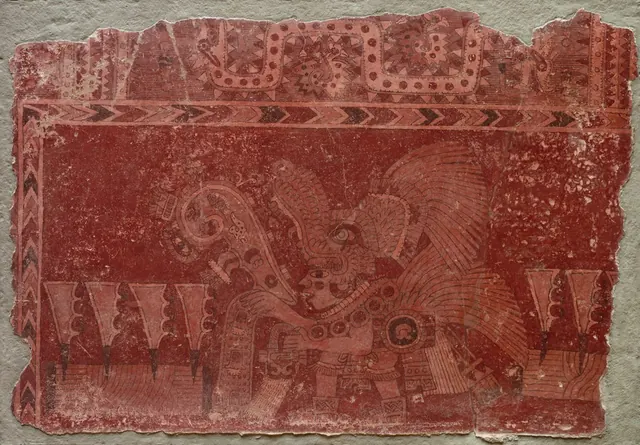
This fragment once belonged to a painted procession in a wealthy residential compound at Teotihuacan, a city in central Mexico. The mural dates to 500–550. Identically dressed ritual participants repeated along the walls of a patio. A single figure survives here and can easily resemble an independent portrait. Originally it formed part of an architectural rhythm among which people lived and performed ceremonies.
The face appears in profile beneath an enormous decorated headdress, nearly rivalling the body in size. Round ornaments, elaborate costume edges and feathers establish the participant’s high status. Repeating identical figures emphasised a shared role and group affiliation. Elite standing became visible through the capacity to participate in ritual wearing such regalia.
A large scroll issues from the mouth, giving chant or prayer a visible form. Its line describes no tangible object but connects the person’s voice to the space before him. The mural makes the action continuous. Its participant continues to offer prayer whenever a viewer passes along the wall.
A stream filled with flowers descends from one hand. The museum identifies it as a libation, a liquid offering. Flowers within the stream connect the ceremony with abundance and plant life. The flowing line moves downwards from hand to earth. The offering becomes a relationship between a person and the environment sustaining the community.
Pointed maguey leaves repeat beside the figure. Their spines may refer to ritual bloodletting, while the plant supplied sap for pulque. An everyday resource also belonged to offering practices. Plants appear here as ordered signs. Their repeated forms sustain the ceremonial repetition of the entire wall.
A separate band of geometric pattern and an elaborate creature runs above the person. Several horizontal levels organise the image. Red tones unite figure, plants and upper ornament while dark outlines distinguish them. This construction suits a wall experienced both as a whole and through movement along it. It gives the ceremony an enduring order beyond an individual gesture.
The person’s high status is presented through an offering. Power can thus appear as a duty to maintain relations with sacred forces and as a right to act on others’ behalf. Other inhabitants are absent from the fragment. One richly dressed participant stands for a whole community, and repetition of his image established that representation within residential space. This surviving piece of wall shows how closely ritual action could be connected to the city’s social organisation.
- Medium
- fresco on wall fragment
- Collection
- Cleveland Museum of Art
- Dimensions
- Overall, 83.2 × 116.2 cm
- Accession number
- 1963.252
Sources
Image provided under CC0. Image licence