The Advance-Guard, or The Military Sacrifice (The Ambush)
Frederic Remington · 1890
Explore the painting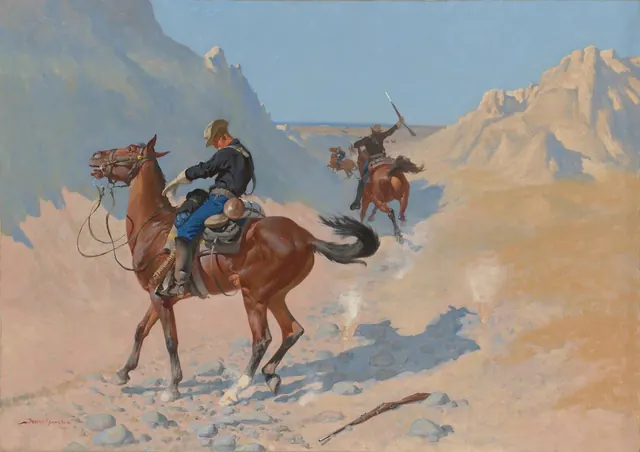
A cavalry scout slumps in the saddle while his companions turn and escape the gunfire. Frederic Remington painted The Advance-Guard in 1890. The museum identifies the unseen shooter as a Sioux warrior. We never see him. The event is organised from the cavalry’s perspective, directing the viewer’s sympathy.
The rider’s head drops, and his hand no longer controls the reins. His posture conveys the loss of control without a close view of a wound. Occupying the foreground, he arrests attention. The human cost of military advance begins with him, although the conflict’s causes remain outside the frame.
The horse jerks its head upwards. Taut and slack harness, open mouth and spread legs make its reaction tangible. Remington became known for his attention to horses, equipment and movement. Such details lent credibility for an audience that might never have visited the American West.
The next rider raises his weapon and turns away. His movement leads towards the other cavalrymen in the distance. A short sequence of actions occupies one instant. The first man has been hit, the second reacts, and the distant figures carry the movement onward as danger spreads through the unit.
A dark horse shadow falls across pale ground. Sharp sunlight and the nearly empty passage between rocks make movement conspicuous. The source of the shot nevertheless remains hidden. The landscape offers an extensive view while withholding the principal threat, making us share the soldiers’ limited knowledge.
A rifle lies near the bottom edge, separated from the man who can no longer use it. The detail completes the account of suddenly interrupted action. The alternative title includes the phrase Military Sacrifice, encouraging an interpretation of the scout through the idea of duty and self-sacrifice.
Pale cliffs enclose the route. Remington travelled west to gather material, but made this painting in his New York studio. Harper’s Weekly later reproduced it alongside his writing. Painting and mass publication helped circulate an image of the West as a place of danger, military courage and adventure.
Native people enter the narrative through an unseen shot. Their circumstances, land and reasons for resistance are absent. That omission matters as much as accurate harness or convincing movement. The painting offers a powerful experience of danger but only one side of a colonial encounter.
- Medium
- Oil on canvas
- Collection
- Art Institute of Chicago
- Dimensions
- 87.3 × 123.1 cm
- Accession number
- 1982.802
Sources
Image provided under CC0. Image licence
Adapted and translated from Art Institute of Chicago materials. · Text licence