Arrangement in Flesh Color and Brown: Portrait of Arthur Jerome Eddy
James McNeill Whistler · 1894
Explore the painting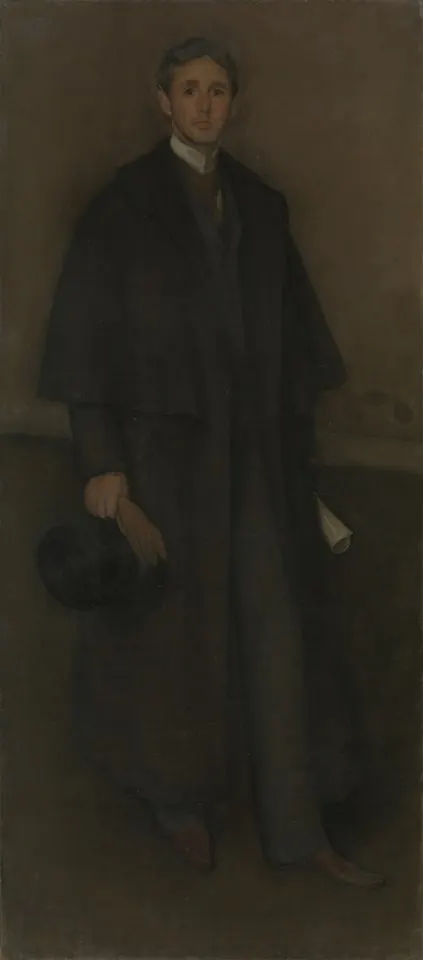
The Chicago lawyer Arthur Jerome Eddy saw Whistler’s work at the 1893 world’s fair and travelled to Paris to commission his portrait. It was painted in 1894. The commission began a lasting acquaintance. Eddy later published a book about Whistler and recorded memories of his working practice.
The face emerges from dark surroundings. It occupies a small part of the tall canvas but attracts attention through light. Whistler leaves considerable space around the sitter. The full-length format gives Eddy an imposing presence, while the upright head and quiet stance preserve restraint.
A white collar separates the head from the clothing. Related greys and blacks gradually become distinguishable within the suit. The museum notes an exceptionally thin paint layer. Whistler unifies the figure by letting some passages almost disappear against the background, retaining clarity in a few light areas.
Gloves appear in his hand. Alongside the outer clothing, they present someone prepared to enter society. Eddy holds no legal documents and has no office furnishings. His profession belongs to the commission’s history; the portrait concentrates on bearing and appearance.
A hat darkens the area beside his lowered hand. Its outline partly merges with the coat. Eddy’s recollections and correspondence indicate several weeks of work in Paris. Whistler continued making changes, and his sitter left before the finished canvas was dispatched. The silhouette’s apparent simplicity followed sustained labour.
A white handkerchief on the right forms a small bright patch far from the face. These separated accents connect the figure over its full height. In a letter of 5 December 1894, Eddy reported the painting’s arrival in Chicago and its first responses. Discussion concerned both the painting’s quality and its likeness.
The feet stand near the lower edge, while the floor barely separates from the background. Placing the man in a particular room is difficult. This uncertainty concentrates attention on his stance. Viewers receive a public image whose setting does not explain his status.
According to Eddy’s letter, his wife admired the picture but felt the portrait did not quite do him justice. Eddy himself was pleased with both the image and the likeness. Their disagreement preserves different expectations. A sitter, his family and the artist can value different qualities in one portrait even while agreeing on its merits.
- Medium
- Oil on canvas
- Collection
- Art Institute of Chicago
- Dimensions
- 210.7 × 93.3 cm
- Accession number
- 1931.501
Sources
Image provided under CC0. Image licence
Adapted and translated from Art Institute of Chicago materials. · Text licence