Bamboo-Covered Stream in Spring Rain
Xia Chang · Ming dynasty (1368–1644), dated 1441
Explore the painting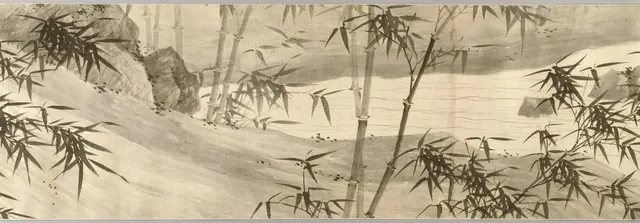
Xia Chang painted this bamboo in 1441 for a friend who had planted a grove beside his retirement home. The dedication connects the garden with release from ordinary concerns and the trials of office. The artist knew that life well. He had served as a court calligrapher, draftsman and administrator, leaving office in 1439 to care for his elderly mother. Duties, ageing and choices about living stand behind this quiet scene.
Stems cross the upper and lower edges. We see a narrow strip of the grove at close range. The complete handscroll is about fifteen metres long; this reproduction shows a section. Viewers would unroll it gradually, encountering one passage after another. Its original format gave the landscape a duration that a single screen cannot fully convey.
Dark foreground leaves were made with individual brush movements. Changes of pressure and direction alter each mark's width. Calligraphic training becomes a way of representing vegetation. A viewer could recognise bamboo while also judging the assurance of the hand that recorded it.
Leaves on the right form dense groups with openings between them. Changing rhythms prevent the long grove from becoming one repeated pattern. Within Chinese scholarly culture, flexible bamboo exemplified resilience: bending under pressure while remaining intact. This is a human moral interpretation of a plant, sustained by cultural tradition.
Pale stems behind the darker branches seem to dissolve in damp air. Different ink strengths establish depth without a range of colours. The title invites us to recognise spring rain, although individual drops are not described. Weather emerges through the image's overall atmosphere and softened distances.
Thin undulating lines describe the stream. It gives the eye an open passage beyond the crowded foliage. The slower drawing of water interrupts the larger brush movements. Such changes help sustain attention as the scroll unfolds.
The angular bank rock is painted differently from the leaves. Broken edges and broad washes give it weight. The museum associates the work’s mature fluency with Xia’s retirement. Solid bank, flowing water and flexible stems require different brush movements. A calligrapher’s long experience conveys these differences within monochrome painting.
A gift to a friend shows that withdrawal from office preserved connections among educated people. The garden could offer personal refuge and a subject for cultural exchange. The landscape therefore supports two perspectives. It promises relief from public duties while expressing the values of the same scholarly and official community. Seclusion has a social history here.
- Medium
- Handscroll; ink on paper
- Collection
- Art Institute of Chicago
- Dimensions
- 41.3 × 1500 cm
- Accession number
- 1950.2
Sources
Image provided under CC0. A detail of the scroll is shown. Dimensions refer to the work catalogued by the museum. Image licence
Adapted and translated from Art Institute of Chicago materials. · Text licence