Composition (No. 1) Gray-Red
Piet Mondrian · 1935
Explore the painting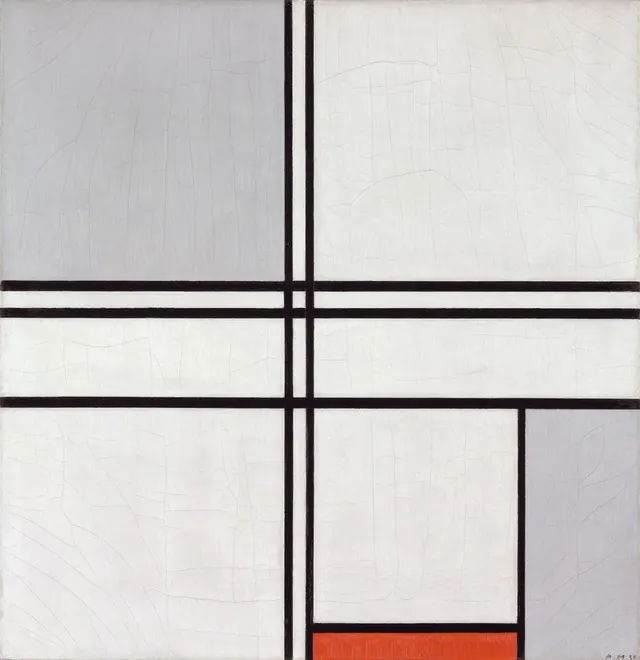
Piet Mondrian painted this composition in 1935, when his language of straight lines and restricted colour was well established. After the First World War, artists associated with De Stijl linked a new visual order to hopes for a more harmonious society. Mondrian joined the movement in 1917. Abandoning recognisable objects made it possible to seek relationships independent of a particular subject or national tradition.
A red rectangle sits at the bottom edge. Its area is small compared with the white and grey fields, but its saturation immediately attracts attention. Balance develops between unequal quantities. A small accent of colour can counter a much larger pale surface.
Two closely spaced verticals cross almost the entire canvas. The narrow white interval becomes an independent element. Mondrian worked particularly actively with doubled lines in the early 1930s. They complicated the rhythm while preserving his restriction to horizontal and vertical directions.
Two horizontals lie relatively close together, with another farther below. Unequal intervals make the eye compare strips and fields. In a 1930 essay Mondrian described rectangular planes as the outcome of intersecting lines. This changes how we look: boundaries and the spaces they generate become a single action.
A broad white field remains on the left. Variations in the paint surface and traces of time are visible within it. This strict geometry was made by hand on canvas, so its material life differs from an immaculate digital diagram. Close examination returns an abstract system to the scale of individual movements and decisions.
A grey-white area on the right is bounded by a black vertical. Its quiet tone differs from neighbouring white, although a quick glance may merge them. Small distinctions carry considerable weight in this painting. A change in line width or field colour alters relationships throughout the composition.
A universal language remained an ambitious hope that the painting itself could not guarantee. One viewer may experience equilibrium, another the pressure of a grid and its restrictions. The work leaves room to test these responses through personal experience. Mondrian offers shared elements, but each encounter with them remains individual.
- Medium
- Oil on canvas
- Collection
- Art Institute of Chicago
- Dimensions
- 57.5 × 55.6 cm
- Accession number
- 1949.518
Sources
Image provided under CC0. Image licence
Adapted and translated from Art Institute of Chicago materials. · Text licence