Tarquin and Lucretia
Tintoretto · 1578–80
Explore the painting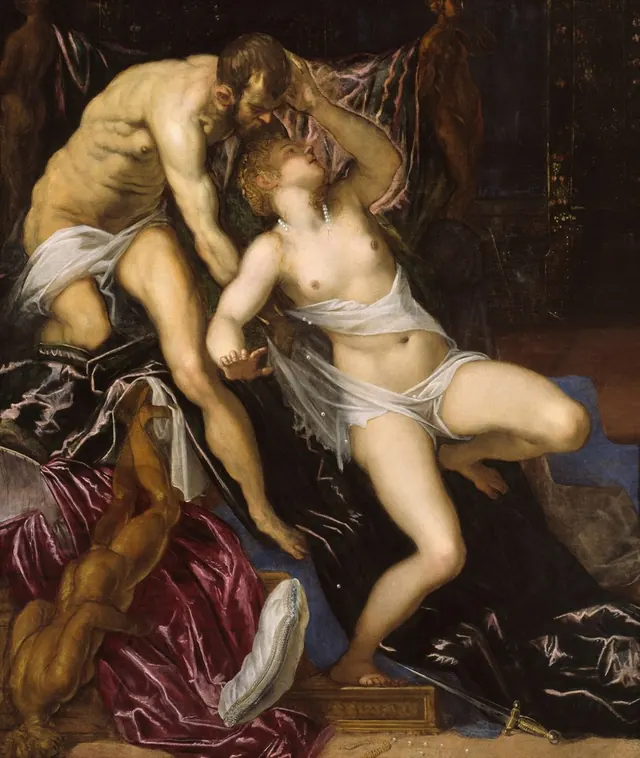
This painting draws on a Roman account of a crime that brought about a change of government. Sextus Tarquinius, son of Rome’s last king, raped Lucretia. According to the ancient narrative, her subsequent death prompted the expulsion of the royal family and the establishment of the republic. Around 1578–1580, Tintoretto placed this political story within the cramped, unstable space of a bedroom.
Tarquin looms over Lucretia from the left. His lowered head, shoulder and bent leg intensify the pressure on her figure. The viewer stands close to the assault, without the protective distance of an expansive historical composition. The king’s son’s crime acquires an immediate human scale.
Lucretia turns her face upwards while her body tilts to the right. The direction of her head differs from that of her torso and legs. This difficult pose conveys struggle and the loss of support. Sixteenth-century Venetians knew the story from ancient writers and numerous images, so they could mentally continue the event beyond the chosen moment.
The raised arm and stretched fabric connect her figure to the upper edge. Almost everything moves. Tintoretto was particularly interested in complex bodily turns, abrupt changes of light and tightly colliding figures. Here these devices make violence physically legible through the collapse of balance.
A pearl necklace breaks across her chest, and pale fabric gathers at her waist. The furnishings of a wealthy household enter the action. Roman tradition tied Lucretia’s fate to family honour, and later generations praised her suicide as exemplary virtue. That historical ideal placed the consequences of a man’s crime on a woman, a circumstance that changes a modern reading of the subject.
A carved support incorporating a human figure falls at the lower left. It resembles another participant in the catastrophe, although it belongs to the room’s furnishings. Tintoretto makes the furniture itself unstable. The wooden figure’s tilt echoes Lucretia’s movement and extends the struggle throughout the setting.
A displaced pillow lies near the bottom edge. Its white patch links the bed to a floor scattered with small objects. The painter gathers several simultaneous consequences of a movement into one image. We notice them successively, although the depicted instant already contains the whole scene.
A sword is visible on the floor. It recalls the armed threat associated with Tarquin’s assault in the ancient account. The gleam of metal and jewellery sits beside human vulnerability. The room’s luxury sharpens the question of power in this wealthy world and whom that power protects.
Other Venetian painters selected different moments. Veronese showed Lucretia before her suicide; Titian depicted the assault. Comparing these choices reveals how painting directs attention towards crime, resistance and subsequent remembrance. In Tintoretto, the grand story of the republic’s foundation begins with a woman whose private catastrophe later became a public example.
- Medium
- Oil on canvas
- Collection
- Art Institute of Chicago
- Dimensions
- 175 × 151.5 cm
- Accession number
- 1949.203
Sources
Image provided under CC0. Image licence
Adapted and translated from Art Institute of Chicago materials. · Text licence